
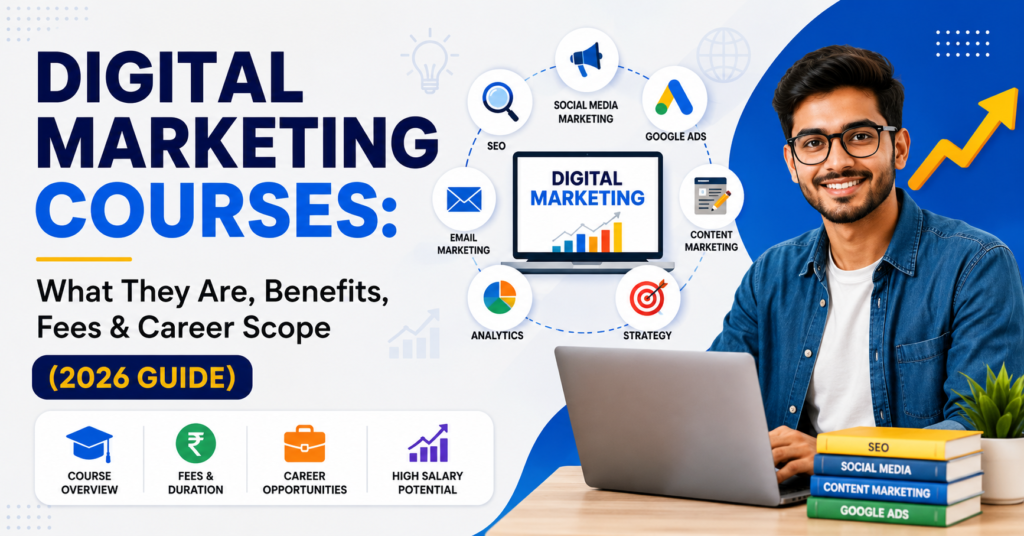
Digital marketing has become one of the fastest-growing career fields in India and around the world. Today, businesses of all sizes—from startups and local shops to multinational companies—use digital platforms to reach their customers. As a result, the demand for skilled digital marketers has increased significantly over the past few years.
If you are a student planning your career, a working professional looking to switch industries, a freelancer wanting to expand your services, or a business owner aiming to grow online, you might have come across the question: What is digital marketing course?
Understanding what is digital marketing course is the first step toward building a successful career in today’s digital-first economy. A digital marketing course teaches you the skills required to promote products, services, and brands using online channels such as search engines, social media platforms, websites, email, and paid advertisements.
Unlike traditional marketing, digital marketing allows businesses to measure results, target specific audiences, and optimize campaigns in real time. Because of these advantages, companies are actively hiring professionals who understand digital marketing tools and strategies.
According to multiple industry reports, India’s digital economy is expected to continue growing rapidly over the next few years. With millions of businesses investing in online marketing, professionals with digital marketing skills are likely to enjoy better job opportunities, competitive salaries, freelance projects, and entrepreneurial success.
However, choosing the right course can feel overwhelming because there are hundreds of institutes, certifications, online programs, and training academies available today. Each course claims to be the best, making it difficult for beginners to decide where to start.
This comprehensive guide answers the most common question—what is digital marketing course—while also explaining its benefits, syllabus, fees, eligibility, duration, career opportunities, salaries, and some of the best institutes in Mumbai. By the end of this guide, you’ll have a clear understanding of whether a digital marketing course is the right investment for your future.
What Are Digital Marketing Courses?
The most common question among beginners is what is digital marketing course.
Simply put, a digital marketing course is a structured training program that teaches you how to market products, services, and brands through digital channels. These courses combine theoretical concepts with practical training so that learners can apply their knowledge in real-world business scenarios.
Instead of relying only on newspapers, television advertisements, radio commercials, or billboards, modern businesses focus on platforms where customers spend most of their time—Google, YouTube, Instagram, Facebook, LinkedIn, email, websites, and mobile apps. Digital marketing professionals help businesses attract customers, generate leads, increase website traffic, improve brand visibility, and drive online sales.
A well-designed digital marketing course covers the complete customer journey—from creating awareness to generating conversions and building long-term customer relationships.
What Does a Digital Marketing Course Teach?
Most professional digital marketing courses include training on the following topics:
- Search Engine Optimization (SEO)
- Google Ads (PPC Advertising)
- Social Media Marketing
- Content Marketing
- Email Marketing
- Search Engine Marketing (SEM)
- Meta Ads (Facebook & Instagram Advertising)
- Google Analytics
- Website Planning
- Lead Generation
- Marketing Automation
- AI Tools for Marketing
- Performance Marketing
- E-commerce Marketing
- Online Reputation Management
In addition to technical skills, learners also develop analytical thinking, communication skills, campaign planning abilities, and data interpretation skills, all of which are highly valued by employers.
Why Are Digital Marketing Courses So Popular?
The popularity of digital marketing courses has grown because businesses are increasingly shifting their marketing budgets from traditional advertising to digital platforms.
For example, instead of spending lakhs of rupees on newspaper advertisements, a company can run highly targeted online campaigns that reach customers based on their age, interests, location, and purchasing behaviour. This makes digital marketing more cost-effective and measurable.
As a result, organizations actively seek professionals who can:
- Improve website rankings on Google.
- Generate quality leads.
- Increase online sales.
- Manage social media communities.
- Run paid advertising campaigns.
- Analyse marketing performance.
- Build brand awareness online.
This growing demand has made digital marketing one of the most sought-after career options in India.
Difference Between Traditional Marketing and Digital Marketing
Understanding the difference between traditional and digital marketing helps you appreciate the value of learning digital skills.
| Traditional Marketing | Digital Marketing |
|---|---|
| Uses newspapers, TV, radio, and billboards | Uses Google, websites, social media, email, and mobile apps |
| Difficult to measure results | Easy to track every click and conversion |
| Expensive advertising | Flexible budgets suitable for businesses of all sizes |
| Targets a broad audience | Targets highly specific customer groups |
| Limited interaction with customers | Two-way communication and engagement |
| Campaigns cannot be changed easily | Campaigns can be optimized instantly |
This flexibility is one of the main reasons businesses prefer digital marketing today.
Who Should Enroll in a Digital Marketing Course?
One of the biggest advantages of digital marketing is that almost anyone can learn it. Unlike many technical fields, you don’t need an engineering degree or coding expertise to get started.
A digital marketing course is suitable for:
- Students preparing for their first job
- Fresh graduates exploring career opportunities
- Working professionals planning a career switch
- Entrepreneurs looking to grow their businesses online
- Freelancers wanting to offer digital marketing services
- Sales and marketing professionals upgrading their skills
- Homemakers restarting their careers
- Small business owners who want to generate online leads
Whether your goal is getting a high-paying job, earning through freelancing, building your own agency, or promoting your business online, learning digital marketing can open multiple career paths.
What Makes a Good Digital Marketing Course?
Not all courses are the same. A quality digital marketing course should go beyond classroom theory and focus on practical implementation.
Look for a course that includes:
- Industry-relevant curriculum
- Live projects and case studies
- Hands-on experience with marketing tools
- AI-integrated learning modules
- Internship opportunities
- Placement assistance
- Industry-recognized certifications
- Experienced trainers
- Lifetime access to learning resources
Practical exposure is especially important because employers prefer candidates who have already worked on real campaigns rather than only studying concepts.
Is a Digital Marketing Course Worth It in 2026?
The simple answer is yes.
Businesses across industries—including healthcare, education, finance, real estate, travel, e-commerce, entertainment, and technology—are investing heavily in digital marketing. As online competition increases, companies need skilled professionals who can help them stand out.
Learning digital marketing not only improves your employability but also equips you with skills that remain valuable even if you decide to start your own business in the future.
More importantly, digital marketing is a continuously evolving field. New technologies such as artificial intelligence, automation, voice search, and data-driven marketing are changing how businesses interact with customers. A modern digital marketing course prepares learners for these emerging trends, ensuring they stay competitive in the job market.
Now that you understand what is digital marketing course, the next step is to explore why learning digital marketing has become one of the smartest career decisions in 2026.
H2: Why Learn Digital Marketing in 2026?
After understanding what is digital marketing course, the next important question is whether learning digital marketing is still a good career choice in 2026.
The answer is yes.
Digital marketing is no longer limited to large companies or e-commerce brands. Today, almost every business—whether it’s a local bakery, coaching institute, hospital, real estate company, clothing brand, or multinational corporation—needs an online presence to attract customers. This has created a huge demand for skilled digital marketing professionals across industries.
A digital marketing course equips you with practical skills that businesses actively seek. Unlike many traditional courses that focus mainly on theory, digital marketing training helps you work on real campaigns, use industry tools, and understand how businesses generate leads and sales online.
Let’s explore why enrolling in a digital marketing course can be one of the smartest career decisions in 2026.
H3: Growing Industry Demand
India is one of the fastest-growing digital economies in the world. Every year, more businesses are moving online to reach customers through Google Search, YouTube, Instagram, Facebook, LinkedIn, WhatsApp, and e-commerce platforms.
This digital transformation has increased the demand for professionals who understand online marketing strategies.
Whether a company wants to:
- Increase website traffic
- Generate quality leads
- Improve Google rankings
- Build a strong social media presence
- Run paid advertising campaigns
- Boost online sales
they need skilled digital marketers to achieve these goals.
This is one of the biggest reasons why people search for what is digital marketing course before planning their careers. They want to gain practical skills that are relevant in today’s job market.
According to industry trends, the demand for digital marketing professionals is expected to continue growing over the next several years as businesses increase their investment in digital channels.
H3: High-Paying Career Opportunities
One of the biggest advantages of completing a digital marketing course is the wide variety of career opportunities available.
Unlike many professions where growth depends on years of experience alone, digital marketing rewards practical skills and measurable results. If you can successfully generate leads, improve website traffic, or increase online sales, employers are often willing to pay attractive salaries.
Some of the most popular job roles after completing a digital marketing course include:
- Digital Marketing Executive
- SEO Executive
- SEO Specialist
- Performance Marketing Executive
- Google Ads Specialist
- Social Media Manager
- Content Marketing Executive
- Email Marketing Specialist
- Marketing Automation Executive
- Digital Marketing Analyst
- Web Analytics Specialist
- Performance Marketing Manager
- Growth Marketer
- Digital Marketing Manager
Many professionals also specialize in one area, such as SEO or paid advertising, while others become full-stack digital marketers with expertise across multiple channels.
As your experience grows, your earning potential increases significantly.
H3: Excellent Career Growth
Digital marketing offers faster career progression compared to many traditional industries.
A beginner usually starts as a Digital Marketing Executive or SEO Executive. With experience, they can move into senior positions such as:
- Team Lead
- Digital Marketing Strategist
- Performance Marketing Manager
- Growth Marketing Manager
- Head of Digital Marketing
- Marketing Consultant
Some experienced professionals even start their own digital marketing agencies or become independent consultants serving multiple clients.
Since digital marketing is a skill-based profession, continuous learning and hands-on experience often matter more than academic qualifications.
H3: Remote Work and Freelancing Opportunities
One of the biggest reasons students and working professionals are interested in understanding what is digital marketing course is the flexibility it offers.
Unlike many office-based jobs, digital marketing allows professionals to work from almost anywhere with a laptop and an internet connection.
After gaining experience, you can choose to:
- Work remotely for Indian companies
- Work with international clients
- Become a freelance digital marketer
- Start your own consulting business
- Build a digital marketing agency
- Offer specialized services like SEO, Google Ads, or Social Media Marketing
Many freelancers earn income from multiple clients instead of depending on a single employer.
This flexibility makes digital marketing particularly attractive for:
- College students
- Homemakers
- Parents returning to work
- Career switchers
- Working professionals seeking additional income
H3: Great Option for Entrepreneurs and Business Owners
Digital marketing isn’t only for job seekers.
If you own a business—or plan to start one—learning digital marketing can help you attract more customers without relying entirely on traditional advertising agencies.
After completing a digital marketing course, you’ll understand how to:
- Create a professional website
- Improve your Google rankings
- Generate quality business leads
- Build a loyal social media community
- Run targeted advertising campaigns
- Increase online sales
- Measure marketing performance
These skills help business owners make informed marketing decisions while reducing customer acquisition costs.
Whether you run a restaurant, clothing brand, coaching institute, clinic, or real estate business, digital marketing knowledge can directly contribute to business growth.
H3: No Technical Background Required
One of the biggest myths about digital marketing is that you need coding knowledge or a computer science degree.
In reality, anyone can learn digital marketing.
Whether you come from:
- Commerce
- Arts
- Science
- Engineering
- Management
- Hospitality
- Healthcare
- Teaching
you can build a successful career in this field.
Most digital marketing tools are designed with user-friendly interfaces, making them easy for beginners to learn.
While having analytical thinking and creativity is helpful, coding is generally not required for most digital marketing roles.
This accessibility is another reason why digital marketing has become one of India’s most popular career choices.
H3: Learn Practical Skills Instead of Only Theory
Traditional education often focuses heavily on theoretical concepts.
A good digital marketing course, however, emphasizes practical learning.
Students typically work on:
- Live websites
- SEO audits
- Google Ads campaigns
- Social media strategies
- Content planning
- Keyword research
- Website analytics
- Email campaigns
- Marketing reports
- AI-powered marketing tools
This practical exposure helps learners build confidence before entering the job market.
Employers also prefer candidates who can demonstrate real-world project experience rather than only theoretical knowledge.
H3: AI Is Transforming Digital Marketing
Artificial Intelligence (AI) is reshaping how businesses market their products and services.
Today’s marketers use AI tools to:
- Generate content ideas
- Write marketing copy
- Create images
- Analyze customer behaviour
- Optimize advertising campaigns
- Improve email marketing
- Conduct keyword research
- Automate repetitive tasks
However, AI does not replace digital marketers. Instead, it helps professionals work more efficiently and make data-driven decisions.
Modern digital marketing courses now include training on AI-powered tools so students can stay ahead of industry trends.
Learning how to combine human creativity with AI technology has become an important skill for future marketers.
H3: Opportunity to Earn While Learning
Unlike many professional courses, digital marketing allows motivated learners to start earning even before completing their training.
After developing skills in areas like SEO, content writing, social media management, or paid advertising, students can take up:
- Freelance projects
- Internship opportunities
- Part-time assignments
- Local business marketing
- Personal branding projects
This practical experience strengthens your portfolio and makes it easier to secure full-time employment later.
Many successful digital marketers began by managing the social media pages of local businesses or optimizing small websites before progressing to larger projects.
H3: Future-Proof Career with Global Opportunities
As internet usage continues to grow, businesses worldwide are investing more in digital marketing.
This means your skills are not limited to one city or even one country.
With the right expertise, you can work for:
- Startups
- Digital marketing agencies
- Large corporations
- E-commerce companies
- Educational institutions
- Healthcare organizations
- SaaS companies
- International clients
Digital marketing skills are transferable across industries, making it easier to adapt to changing job markets and economic conditions.
Key Takeaway
If you’ve been wondering what is digital marketing course and whether it’s worth pursuing in 2026, the answer is clear.
A digital marketing course offers much more than just a certificate. It equips you with practical, job-ready skills that can help you secure employment, build a freelance career, grow your business, or even launch your own agency.
With increasing digital adoption, attractive salary potential, flexible work options, and the growing role of AI in marketing, digital marketing remains one of the most promising career choices for students, professionals, entrepreneurs, and career switchers alike.
In the next section, we’ll explore the different types of digital marketing courses, helping you understand which option best matches your career goals, budget, and learning style.
H2: Types of Digital Marketing Courses
Once you understand what is digital marketing course and why it is an excellent career option, the next step is choosing the right type of course.
Today, there are hundreds of digital marketing courses available in India. Some are designed for complete beginners, while others are meant for experienced professionals who want to upgrade their skills.
Choosing the right course depends on several factors, including:
- Your current education level
- Career goals
- Budget
- Available time
- Preferred learning mode
- Whether you want a job, freelance career, or business growth
Let’s explore the different types of digital marketing courses so you can make an informed decision.
H3: Beginner Digital Marketing Courses
Beginner courses are the best option for people who have little or no prior knowledge of digital marketing.
These courses start with the fundamentals and gradually introduce students to advanced concepts. They are ideal for anyone asking, “What is digital marketing course, and how do I get started?”
A beginner course usually covers:
- Introduction to Digital Marketing
- Website Basics
- Search Engine Optimization (SEO)
- Social Media Marketing (SMM)
- Google Ads
- Content Marketing
- Email Marketing
- Google Analytics
- Basic AI Tools for Marketing
Most beginner programs also include practical assignments to help students apply what they learn.
Best Suited For:
- Students
- Fresh graduates
- Career switchers
- Homemakers
- Small business owners
- Freelancers starting their journey
H3: Advanced Digital Marketing Courses
Advanced courses are designed for professionals who already understand the basics of digital marketing.
Instead of introducing concepts, these programs focus on mastering advanced strategies and tools.
Topics often include:
- Advanced SEO
- Performance Marketing
- Conversion Rate Optimization (CRO)
- Marketing Automation
- AI-Powered Marketing
- Data Analytics
- Advanced Google Ads
- Meta Ads Optimization
- Funnel Building
- Lead Generation Strategies
These courses are particularly useful for professionals aiming for managerial roles or specialized positions.
Best Suited For:
- Working professionals
- Marketing executives
- Business owners
- Agency professionals
- Experienced freelancers
H3: Certification Courses
Certification courses are among the most popular options because they focus on practical, job-oriented skills and can be completed in a relatively short period.
Most certification programs range from 2 to 6 months, depending on the institute and curriculum.
A good certification course typically includes:
- Practical assignments
- Live projects
- Industry tools
- Case studies
- Internship opportunities
- Placement assistance
- Mock interviews
- Resume-building support
Many institutes also prepare students for globally recognized certifications from platforms such as Google, Meta, HubSpot, and other leading technology companies.
Benefits of Certification Courses
- Short duration
- Affordable fees
- Industry-relevant curriculum
- Faster entry into the job market
- Practical exposure
For most beginners, a certification program is often the best way to start learning digital marketing.
H3: Diploma in Digital Marketing
Diploma courses are generally more comprehensive than certification programs.
They usually last between 6 months and 1 year and cover digital marketing in greater depth.
In addition to core modules, diploma programs may include:
- Branding
- Marketing Strategy
- Business Communication
- Client Management
- E-commerce Marketing
- Media Planning
- Digital Marketing Analytics
- Agency Operations
Some institutes also include internships and capstone projects to prepare students for real-world challenges.
Best Suited For:
- Students looking for detailed learning
- Career switchers
- Professionals planning long-term careers in marketing
H3: Degree Programs in Digital Marketing
Some universities now offer undergraduate and postgraduate degrees with digital marketing as a specialization.
Examples include:
- BBA in Digital Marketing
- MBA in Digital Marketing
- PG Diploma in Digital Marketing
- Executive Management Programs
These programs combine marketing principles with business management concepts.
Although degree programs take longer to complete, they provide a broader understanding of business, branding, consumer behaviour, and marketing strategy.
Best Suited For:
- Students pursuing higher education
- Professionals seeking management positions
- Individuals planning long-term corporate careers
H3: Online Digital Marketing Courses
Online learning has become increasingly popular in recent years.
Many reputed institutes now offer live online classes that provide the same curriculum as classroom programs.
Online digital marketing courses usually include:
- Live instructor-led sessions
- Recorded lectures
- Practical assignments
- Doubt-solving sessions
- Digital study material
- Online assessments
- Certifications
Advantages of Online Courses
- Learn from anywhere
- Flexible schedules
- Lower costs
- Lifetime access to recordings (offered by many institutes)
- Ideal for working professionals
Challenges
- Requires self-discipline
- Limited face-to-face interaction
- Networking opportunities may be fewer compared to classroom learning
If you are managing college or a full-time job, online courses can be a convenient option.
H3: Offline (Classroom) Digital Marketing Courses
Offline courses provide traditional classroom learning with direct interaction between students and trainers.
Many learners prefer classroom training because it offers:
- Face-to-face discussions
- Immediate doubt resolution
- Group activities
- Better networking opportunities
- Classroom discipline
- Hands-on practical sessions
Institutes often provide access to computer labs where students can practice using professional marketing tools.
Best Suited For:
- Students who prefer classroom learning
- Beginners who need regular guidance
- Learners who enjoy collaborative environments
H3: Hybrid Digital Marketing Courses
Hybrid learning combines the benefits of both online and offline education.
Typically, students attend:
- Live classroom sessions
- Online revision classes
- Recorded lectures
- Practical workshops
- Weekend doubt-solving sessions
This format offers greater flexibility while still providing personal interaction with trainers.
Hybrid courses have become increasingly popular among working professionals and college students.
H3: Self-Paced Digital Marketing Courses
Self-paced courses allow students to learn at their own speed.
Instead of attending scheduled classes, learners receive access to pre-recorded video lessons and learning resources.
Advantages
- Study anytime
- Learn at your own pace
- Affordable pricing
- Ideal for busy professionals
Limitations
- Minimal trainer interaction
- No classroom discussions
- Requires high motivation
- Limited placement support
Self-paced learning is best suited for individuals who are comfortable learning independently.
H3: Which Digital Marketing Course Is Right for You?
There is no single “best” digital marketing course for everyone.
The right choice depends on your goals.
| Your Goal | Recommended Course Type |
|---|---|
| Learn the basics | Beginner Certification Course |
| Get a job quickly | Practical Certification Course with Placement Support |
| Switch careers | Certification or Diploma Course |
| Grow your business | Beginner or Advanced Practical Course |
| Become a freelancer | Practical Course with Live Projects |
| Move into management | Advanced Certification or MBA |
| Upgrade existing skills | Advanced Digital Marketing Course |
Before enrolling, ask yourself a few important questions:
- Does the course include live projects?
- Will I learn the latest AI tools?
- Are trainers experienced professionals?
- Does the institute provide internship opportunities?
- Is placement assistance available?
- Will I receive industry-recognized certifications?
- Does the curriculum include hands-on practice instead of only theory?
Choosing a course based on these factors will give you a much better return on your investment.
Key Takeaway
If you’re researching what is digital marketing course, it’s equally important to understand that there are different learning paths available. From beginner certification programs to advanced diplomas and degree courses, each option is designed for a specific type of learner.
For most students, fresh graduates, and career switchers in India, a practical certification course that includes live projects, AI tools, internships, and placement assistance offers the best balance of affordability, hands-on learning, and career readiness.
Now that you know the different types of digital marketing courses, let’s dive into the next section, where we’ll explore what you actually learn in a digital marketing course and the essential skills every digital marketer needs to succeed.
H2: What Will You Learn in a Digital Marketing Course?
If you’ve been searching for what is digital marketing course, you’re probably also wondering what exactly you’ll learn during the training.
A good digital marketing course is much more than learning how to post on social media or run online advertisements. It is a comprehensive program that teaches you how businesses attract customers, generate leads, increase sales, and build strong brands using digital platforms.
Modern digital marketing courses combine theoretical knowledge with practical implementation. Instead of simply reading about marketing concepts, you’ll learn how to use industry tools, work on live projects, analyze campaign performance, and solve real business problems.
Let’s explore the major modules included in most professional digital marketing courses.
H3: Search Engine Optimization (SEO)
Search Engine Optimization (SEO) is one of the most important topics covered in a digital marketing course.
SEO is the process of improving a website’s visibility on search engines like Google so that it appears higher in search results when people search for relevant keywords.
For example, if someone searches for “best digital marketing institute in Mumbai”, businesses aim to rank on the first page of Google because higher rankings usually bring more visitors and potential customers.
During the SEO module, you’ll learn:
- How search engines work
- Keyword research
- On-page SEO
- Off-page SEO
- Technical SEO
- Local SEO
- Image optimization
- Mobile SEO
- Link building
- SEO reporting
- SEO tools such as Google Search Console and keyword research platforms
SEO is considered one of the most in-demand digital marketing skills because businesses constantly strive to improve their organic visibility.
H3: Search Engine Marketing (SEM)
Search Engine Marketing (SEM) focuses on paid advertising through search engines, primarily Google Ads.
Unlike SEO, which takes time to generate results, SEM allows businesses to appear at the top of Google almost immediately by running paid campaigns.
In this module, students learn:
- Google Ads account setup
- Keyword targeting
- Campaign creation
- Ad copywriting
- Budget planning
- Bidding strategies
- Conversion tracking
- Quality Score optimization
- Performance analysis
SEM is widely used for generating leads, online sales, and website traffic.
H3: Social Media Marketing (SMM)
Social media has become one of the most powerful marketing channels for businesses.
A digital marketing course teaches you how to build brand awareness and engage customers using platforms like:
- YouTube
- X (formerly Twitter)
You’ll learn:
- Social media strategy
- Content planning
- Content calendars
- Audience engagement
- Organic growth techniques
- Community management
- Social media analytics
- Platform-specific best practices
Businesses actively hire professionals who can manage their social media presence and create engaging campaigns.
H3: Content Marketing
The phrase “Content is King” is often used in digital marketing because valuable content helps businesses attract and retain customers.
Content marketing involves creating useful, informative, and engaging content that solves users’ problems.
During this module, you’ll learn how to create:
- Blog articles
- Website content
- Landing pages
- Case studies
- Infographics
- E-books
- Product descriptions
- Video scripts
- Social media captions
You’ll also understand how content supports SEO, lead generation, and brand authority.
Good content marketing is not just about writing—it is about understanding customer intent and providing valuable information.
H3: Email Marketing
Despite the rise of social media, email marketing continues to deliver one of the highest returns on investment (ROI) among digital marketing channels.
In this module, you’ll learn how businesses communicate with customers through personalized email campaigns.
Topics generally include:
- Email list building
- Lead nurturing
- Newsletter creation
- Email automation
- Customer segmentation
- Welcome email sequences
- Promotional campaigns
- Performance tracking
Email marketing is widely used by e-commerce companies, educational institutions, SaaS businesses, and service providers.
H3: Affiliate Marketing
Affiliate marketing is a performance-based marketing model where individuals promote products or services and earn a commission for successful sales or leads.
A digital marketing course introduces students to:
- Affiliate marketing basics
- Affiliate networks
- Commission models
- Product selection
- Traffic generation
- Affiliate content strategies
- Performance tracking
This module is especially useful for bloggers, YouTubers, influencers, and freelancers who want to generate passive income.
H3: Influencer Marketing
Influencer marketing has become an essential part of modern brand promotion.
Businesses collaborate with content creators and influencers to reach targeted audiences through authentic recommendations.
During this module, students learn:
- How influencer marketing works
- Choosing the right influencers
- Campaign planning
- Budget management
- Influencer outreach
- Performance measurement
- Brand collaborations
This skill is increasingly valuable as brands invest more in creator-led marketing campaigns.
H3: Google Ads
Google Ads is one of the most important practical modules in a digital marketing course.
You’ll gain hands-on experience in creating different types of campaigns, including:
- Search Ads
- Display Ads
- Shopping Ads
- Video Ads
- Performance Max Campaigns
- App Promotion Campaigns
Students also learn:
- Audience targeting
- Budget optimization
- Keyword bidding
- Ad extensions
- Conversion tracking
- Campaign optimization
Since many businesses rely heavily on paid advertising, Google Ads specialists are in high demand.
H3: Meta Ads (Facebook & Instagram Advertising)
Meta Ads allow businesses to reach highly targeted audiences across Facebook and Instagram.
This module teaches students how to create and manage paid advertising campaigns using Meta Ads Manager.
Topics typically include:
- Campaign objectives
- Audience targeting
- Custom audiences
- Lookalike audiences
- Ad creatives
- Budget optimization
- Lead generation campaigns
- E-commerce advertising
- Retargeting strategies
- Campaign reporting
Meta advertising is widely used by businesses to generate leads, sales, app downloads, and brand awareness.
H3: Google Analytics & Reporting
Marketing decisions should be based on data rather than assumptions.
Google Analytics helps marketers understand how users interact with websites.
You’ll learn:
- Website traffic analysis
- User behaviour
- Traffic sources
- Goal tracking
- Conversion measurement
- Audience insights
- Campaign performance
- Report generation
Understanding analytics enables marketers to continuously improve campaign performance and maximize return on investment.
H3: Website Planning and Landing Pages
Every digital marketer should understand the basics of websites.
Although advanced coding is not required, you’ll learn how websites are structured and how landing pages influence conversions.
Topics generally include:
- Domain and hosting basics
- Website structure
- User experience (UX)
- Landing page optimization
- Conversion-focused design
- Lead generation forms
- Call-to-action (CTA) placement
This knowledge helps marketers collaborate effectively with web designers and developers.
H3: Marketing Automation
As businesses grow, manually managing every marketing activity becomes difficult.
Marketing automation helps streamline repetitive tasks.
Students learn about:
- Automated email workflows
- Lead nurturing
- CRM integration
- Customer journey mapping
- Workflow automation
- Trigger-based campaigns
Automation improves efficiency while delivering personalized customer experiences.
H3: AI Tools in Digital Marketing
Artificial Intelligence has become an integral part of digital marketing.
A modern digital marketing course introduces learners to AI-powered tools that enhance productivity and creativity.
Students may learn how to use AI for:
- Content generation
- Keyword research
- Blog outlines
- Image creation
- Video scripting
- Email drafting
- Ad copy generation
- Competitor research
- SEO optimization
- Data analysis
It’s important to understand that AI supports marketers rather than replacing them. Human creativity, strategic thinking, and decision-making remain essential for successful marketing campaigns.
H3: Soft Skills You’ll Develop
In addition to technical knowledge, a quality digital marketing course also helps you develop important professional skills.
These include:
- Communication skills
- Analytical thinking
- Creativity
- Problem-solving
- Time management
- Presentation skills
- Client communication
- Project management
- Team collaboration
These transferable skills are valuable in almost every industry.
H3: Practical Learning Through Live Projects
One of the biggest advantages of enrolling in a professional digital marketing course is the opportunity to work on practical assignments.
Instead of only studying concepts, students often gain hands-on experience by working on:
- Live websites
- SEO audits
- Google Ads campaigns
- Social media content calendars
- Blog writing
- Landing pages
- Keyword research projects
- Website optimization
- Marketing reports
- Real client campaigns (in some institutes)
Practical experience builds confidence and prepares students for interviews and real-world job responsibilities.
Key Takeaway
When people ask, “What is digital marketing course?”, they often assume it focuses only on social media or online advertising.
In reality, a comprehensive digital marketing course teaches a wide range of skills—from SEO and Google Ads to content marketing, analytics, email marketing, AI tools, and marketing automation.
The goal is not just to help you understand digital marketing concepts but to make you job-ready through practical training and hands-on experience. Whether you plan to work for a company, start freelancing, or grow your own business, these skills provide a strong foundation for long-term success.
In the next section, we’ll discuss who should join a digital marketing course and help you determine whether it’s the right fit for your educational background, career stage, and future goals.
H2: Who Should Join a Digital Marketing Course?
One of the biggest advantages of digital marketing is that it is open to almost everyone. Unlike many professional courses that require a specific educational background or technical degree, digital marketing focuses more on practical skills than academic qualifications.
If you’re wondering what is digital marketing course and whether it’s the right choice for you, the answer depends on your career goals—not necessarily on your educational background.
Whether you’re a student planning your future, a professional looking for a career change, or a business owner wanting to grow online, a digital marketing course can help you develop valuable, future-ready skills.
Let’s look at who can benefit the most.
H3: Students
Students are among the biggest beneficiaries of digital marketing courses.
The job market is becoming increasingly competitive, and employers are looking for candidates who possess practical, industry-relevant skills in addition to their academic qualifications.
Learning digital marketing while you’re still studying gives you a significant advantage over other candidates.
Benefits for Students
- Build job-ready skills before graduation
- Improve your resume with industry certifications
- Apply for internships while studying
- Start freelancing for additional income
- Develop practical knowledge beyond classroom learning
- Understand how businesses market their products online
Many students begin learning digital marketing in their second or third year of college, making it easier to secure internships and entry-level jobs after graduation.
H3: Fresh Graduates
Many graduates struggle to find jobs because they lack practical experience.
A digital marketing course helps bridge this gap by teaching skills that companies actively require.
Fresh graduates from almost any stream can learn digital marketing, including:
- B.Com
- BBA
- BMS
- BA
- B.Sc
- BCA
- Engineering
- Hotel Management
- Mass Media
- Journalism
Since digital marketing is skill-based, your degree is often less important than your ability to deliver measurable results.
Completing a practical digital marketing course can improve your employability and expand your career options.
H3: Working Professionals
If you’re feeling stuck in your current job or looking for better salary opportunities, digital marketing can be an excellent career transition.
Many professionals switch to digital marketing because it offers:
- Better career growth
- Higher salary potential
- Flexible work opportunities
- Remote work options
- Exposure to modern technology
- Continuous learning
Professionals from various industries have successfully transitioned into digital marketing, including:
- Sales
- Customer Support
- Banking
- Human Resources
- Operations
- Education
- Retail
- Hospitality
Since many concepts can be learned through part-time or weekend classes, working professionals can upgrade their skills without leaving their current jobs.
H3: Business Owners and Entrepreneurs
Digital marketing is not just for people seeking jobs.
If you own a business, understanding digital marketing can help you reduce marketing costs and make better business decisions.
Instead of depending entirely on external agencies, you’ll understand how to:
- Generate online leads
- Improve your website’s Google ranking
- Build your brand on social media
- Run advertising campaigns
- Track marketing performance
- Increase online sales
Even if you eventually hire a marketing agency, having digital marketing knowledge allows you to evaluate campaigns more effectively and ensure your marketing budget is being used wisely.
Whether you run a startup, retail store, coaching institute, clinic, restaurant, or manufacturing business, digital marketing skills can contribute directly to business growth.
H3: Freelancers
Freelancing has become one of the most popular career paths in digital marketing.
Businesses around the world hire freelancers for specialized services instead of maintaining large in-house marketing teams.
After completing a digital marketing course, freelancers can offer services such as:
- Search Engine Optimization (SEO)
- Content Writing
- Social Media Management
- Google Ads Management
- Meta Ads Management
- Email Marketing
- Website Audits
- Local SEO
- Performance Marketing
As you gain experience and positive client reviews, you can increase your pricing and work with clients from different industries and countries.
For individuals who value flexibility and independence, freelancing can be an attractive career option.
H3: Marketing and Sales Professionals
Professionals already working in marketing or sales can significantly enhance their careers by learning digital marketing.
Traditional marketing and sales strategies are increasingly being integrated with digital channels.
Learning digital marketing helps professionals:
- Understand customer behaviour
- Improve lead generation
- Measure campaign performance
- Use data to make better decisions
- Manage integrated marketing campaigns
Adding digital marketing skills to your existing experience can make you more valuable to employers and improve your chances of promotion.
H3: Career Switchers
Many people reach a stage where they feel their current career no longer aligns with their goals.
Some want better salaries, while others seek more flexibility or opportunities in growing industries.
Digital marketing has become a popular choice for career switchers because:
- It does not require years of additional education.
- Most certification courses can be completed within a few months.
- Skills are practical and immediately applicable.
- Job opportunities exist across multiple industries.
- Continuous learning keeps the career dynamic and exciting.
Whether you’re moving from teaching, banking, customer service, engineering, or another profession, digital marketing offers a practical pathway into a rapidly growing field.
H3: Homemakers Returning to Work
Many homemakers who have taken career breaks find it challenging to re-enter the workforce.
Digital marketing provides an excellent opportunity because many roles offer flexible schedules and remote working options.
After completing a digital marketing course, homemakers can explore opportunities such as:
- Freelance content writing
- Social media management
- SEO services
- Email marketing
- Online consulting
- Part-time digital marketing roles
This flexibility allows individuals to balance professional responsibilities with personal commitments.
H3: Anyone Interested in Building a Personal Brand
Today, professionals across industries are building their personal brands online.
Doctors, lawyers, fitness coaches, financial advisors, educators, influencers, and consultants all use digital marketing to grow their online presence.
By learning digital marketing, you can understand how to:
- Build a professional website
- Create valuable content
- Improve your visibility on Google
- Grow your LinkedIn profile
- Build an engaged audience on social media
- Generate business opportunities through content marketing
These skills are valuable regardless of your profession.
H3: Do You Need Coding Knowledge?
One of the most common misconceptions about digital marketing is that coding is mandatory.
The reality is quite different.
For most digital marketing roles, you do not need programming knowledge.
Most marketing tools are designed to be user-friendly, allowing beginners to perform tasks without writing code.
Basic technical understanding is helpful, especially for SEO and website management, but advanced coding skills are generally unnecessary.
Instead, successful digital marketers focus on:
- Creativity
- Communication
- Analytical thinking
- Problem-solving
- Understanding customer behaviour
- Continuous learning
These skills often have a greater impact on career success than technical programming expertise.
H3: Are There Any Age Restrictions?
Another frequently asked question related to what is digital marketing course is whether there is an ideal age to start learning.
The good news is that digital marketing has no age limit.
People from different age groups successfully build careers in this field.
Whether you’re:
- A college student
- A recent graduate
- A working professional in your 30s
- An entrepreneur in your 40s
- A homemaker returning to work
- A retiree starting a consulting business
you can learn digital marketing at your own pace.
Your willingness to learn and practice is far more important than your age.
Key Takeaway
If you’re wondering what is digital marketing course and whether you’re eligible to join one, the answer is simple: digital marketing is for anyone willing to learn practical, in-demand skills.
Students can improve their employability, fresh graduates can become job-ready, working professionals can switch careers, freelancers can expand their services, entrepreneurs can grow their businesses, and homemakers can restart their careers with flexible work opportunities.
The best part is that most digital marketing courses are designed for beginners, so you don’t need prior experience or technical expertise to get started.
In the next section, we’ll discuss the eligibility criteria for digital marketing courses, including educational qualifications, technical requirements, and the essential skills that can help you succeed in this field.
H2: Digital Marketing Course Eligibility
One of the most common concerns among aspiring learners is whether they meet the eligibility requirements for a digital marketing course.
The good news is that the eligibility criteria for most digital marketing courses are simple and beginner-friendly. Unlike professional degrees that require specific educational qualifications or entrance exams, digital marketing courses are designed to be accessible to learners from diverse backgrounds.
If you’ve been searching for what is digital marketing course, you’ll be happy to know that you don’t need an engineering degree, advanced technical knowledge, or years of work experience to begin your journey.
Let’s understand the eligibility requirements in detail.
H3: Educational Qualification
The educational requirements vary depending on the type of digital marketing course you choose.
Certificate Courses
Most certification courses have minimal eligibility requirements.
Generally, you should have completed:
- Class 10 (for some beginner courses)
- Class 12 (preferred by many institutes)
- Graduation (not mandatory for most certification programs)
Many training institutes welcome students who are still pursuing their graduation.
Diploma Courses
Diploma programs usually require:
- Completion of Class 12
- Graduation (preferred in some institutes)
These courses are more detailed and may include advanced marketing concepts.
Degree Programs
For undergraduate and postgraduate degree programs, eligibility depends on the university.
For example:
- BBA in Digital Marketing generally requires Class 12.
- MBA or PG Diploma programs usually require a bachelor’s degree.
H3: Is Graduation Mandatory?
One of the biggest myths surrounding digital marketing is that you must be a graduate to learn it.
The answer is No.
For most professional certification courses, graduation is not mandatory.
Many students start learning digital marketing while they are still in college.
Similarly, entrepreneurs, freelancers, and business owners often enroll in digital marketing courses without worrying about formal educational qualifications.
Ultimately, employers value your practical skills, portfolio, and ability to deliver results more than your degree.
H3: Do You Need a Technical Background?
Absolutely not.
This is another common misconception.
Many people assume digital marketing is only for IT or engineering students.
In reality, learners from almost every educational stream succeed in digital marketing.
You can learn digital marketing if your background is in:
- Commerce
- Arts
- Science
- Engineering
- Pharmacy
- Hotel Management
- Journalism
- Mass Media
- Fashion Designing
- Architecture
- Law
- Education
- Healthcare
Digital marketing focuses on understanding customers, creating valuable content, analyzing data, and using marketing tools—not software development.
H3: Is Coding Required?
One of the most frequently asked questions after “What is digital marketing course?” is whether coding knowledge is necessary.
The answer is No.
Most digital marketing professionals never write complex code.
Instead, they use user-friendly platforms and tools to manage campaigns.
For example:
- Website builders
- Content Management Systems (CMS)
- SEO tools
- Email marketing software
- Social media management platforms
- Analytics dashboards
However, having a basic understanding of HTML can sometimes be helpful for:
- Making minor website edits
- Optimizing landing pages
- Formatting emails
- Understanding website structure
But don’t worry—advanced programming skills are not required for the majority of digital marketing jobs.
H3: Basic Computer Skills Required
Although technical expertise isn’t necessary, you should be comfortable using a computer.
Basic computer knowledge includes:
- Using the internet
- Browsing websites
- Working with Google Chrome
- Using Microsoft Word or Google Docs
- Creating PowerPoint presentations
- Managing files and folders
- Sending emails
- Using spreadsheets like Excel or Google Sheets
If you’re familiar with these basic tasks, you’ll find it easier to learn digital marketing tools.
H3: Communication Skills
Communication plays a major role in digital marketing.
You don’t need perfect English or advanced vocabulary, but you should be able to communicate your ideas clearly.
Good communication helps in:
- Writing blog articles
- Creating social media posts
- Drafting emails
- Preparing reports
- Communicating with clients
- Collaborating with team members
If your communication skills need improvement, don’t let that stop you. They naturally improve with regular practice.
H3: Analytical Thinking
Digital marketing is a combination of creativity and data.
Successful marketers regularly analyze campaign performance to understand what is working and what needs improvement.
Having an analytical mindset helps you:
- Interpret website traffic
- Measure campaign performance
- Understand customer behaviour
- Optimize advertising budgets
- Improve conversion rates
Most digital marketing courses teach these skills through practical assignments and real-world case studies.
H3: Creativity Is an Added Advantage
Creativity isn’t compulsory, but it certainly helps.
Digital marketers often create:
- Social media campaigns
- Blog ideas
- Advertisement concepts
- Video scripts
- Email campaigns
- Marketing strategies
Creative thinking allows marketers to stand out in a competitive digital landscape.
The good news is that creativity can be developed through observation, practice, and experimentation.
H3: Willingness to Learn
Perhaps the most important eligibility requirement is your attitude.
Digital marketing is a rapidly evolving industry.
Google updates its search algorithms.
Social media platforms introduce new features.
AI tools continue to transform workflows.
Consumer behaviour keeps changing.
Successful digital marketers stay curious and continuously update their knowledge.
A willingness to learn new tools and strategies is often more valuable than prior experience.
H3: Do You Need Work Experience?
No.
Most beginner digital marketing courses are specifically designed for people with no prior work experience.
Whether you’re:
- A college student
- A fresher
- A career switcher
- A homemaker
- A business owner
you can start learning digital marketing from scratch.
As you complete practical assignments and live projects during the course, you’ll gradually build the experience needed to apply for internships and jobs.
H3: Skills That Help You Succeed
Although these are not mandatory, developing the following skills can make your digital marketing journey smoother:
- Curiosity to learn new technologies
- Basic research skills
- Time management
- Problem-solving ability
- Creativity
- Communication
- Attention to detail
- Patience
- Adaptability
- Teamwork
These qualities are valued by employers across the digital marketing industry.
H3: Eligibility Checklist
Before enrolling in a digital marketing course, ask yourself these simple questions:
✅ Can I use a computer and browse the internet?
✅ Am I willing to learn new skills?
✅ Do I enjoy solving problems?
✅ Am I interested in marketing or business?
✅ Can I dedicate a few hours every week to learning?
If your answer is yes to most of these questions, you’re already eligible to start learning digital marketing.
Key Takeaway
One of the biggest reasons digital marketing has become such a popular career choice is its accessibility.
If you’ve been asking what is digital marketing course and wondering whether you qualify, the answer is encouraging: most people do.
You don’t need a specific degree, technical background, coding knowledge, or work experience. Basic computer literacy, curiosity, and a willingness to learn are enough to begin.
Whether you’re a student, graduate, working professional, entrepreneur, freelancer, or homemaker, a digital marketing course can provide the practical skills needed to build a rewarding career in today’s digital economy.
In the next section, we’ll discuss the duration of digital marketing courses, helping you understand how long different types of programs take and which option best fits your schedule and career goals.
H2: Digital Marketing Course Duration
One of the first questions learners ask after understanding what is digital marketing course is, “How long does it take to complete a digital marketing course?”
The answer depends on the type of course you choose, your learning goals, and the level of expertise you want to achieve.
Today, digital marketing courses are available in different formats—from short-term certification programs lasting a few weeks to comprehensive diploma and degree programs that span several months or years.
If your goal is to become job-ready as quickly as possible, you don’t necessarily need to spend years studying. Many practical certification courses can help you build industry-relevant skills within a few months.
Let’s look at the different course durations available.
H3: 1-Month Digital Marketing Courses
Short-term courses are designed to introduce learners to the fundamentals of digital marketing.
These programs generally focus on basic concepts such as:
- Introduction to Digital Marketing
- SEO Basics
- Social Media Marketing
- Google Ads Overview
- Content Marketing Basics
- Email Marketing Fundamentals
Best Suited For
- Business owners
- Entrepreneurs
- Professionals looking to understand digital marketing
- Students exploring the field before enrolling in a longer program
Advantages
- Quick learning
- Affordable
- Good introduction to digital marketing
Limitations
- Limited practical exposure
- Doesn’t cover advanced topics in depth
- Usually insufficient for job-ready skills
A one-month course is a good starting point, but if you want to build a career in digital marketing, a more comprehensive program is usually recommended.
H3: 3-Month Digital Marketing Courses
Three-month certification courses are among the most popular options in India.
They provide a balance between theory and practical learning while covering most core digital marketing modules.
A typical 3-month course includes:
- Search Engine Optimization (SEO)
- Google Ads
- Meta Ads
- Social Media Marketing
- Content Marketing
- Email Marketing
- Google Analytics
- Website Basics
- AI Tools for Digital Marketing
Many institutes also include:
- Practical assignments
- Live projects
- Case studies
- Industry certifications
Best Suited For
- College students
- Fresh graduates
- Career switchers
- Freelancers
- Small business owners
For beginners, a well-structured three-month course is often enough to understand the fundamentals and begin applying for internships or entry-level positions.
H3: 6-Month Digital Marketing Courses
If you’re looking for in-depth learning and stronger practical exposure, a six-month digital marketing course is an excellent choice.
These programs typically include everything covered in shorter courses along with advanced modules.
Additional topics often include:
- Advanced SEO
- Performance Marketing
- Marketing Automation
- Conversion Rate Optimization (CRO)
- Advanced Analytics
- E-commerce Marketing
- Lead Generation
- AI-Powered Marketing
- Portfolio Development
Students also spend more time working on:
- Live projects
- Website optimization
- Campaign creation
- Client simulations
- Internship assignments
Best Suited For
- Serious job seekers
- Career switchers
- Professionals seeking specialization
- Entrepreneurs
Many institutes also provide placement support after completing a six-month course.
H3: 1-Year Digital Marketing Programs
One-year diploma or advanced certification programs provide extensive training for learners seeking a deeper understanding of marketing.
These programs generally include:
- Complete digital marketing curriculum
- Branding
- Consumer behaviour
- Marketing strategy
- Business communication
- Advanced analytics
- Capstone projects
- Internship
- Industry exposure
Advantages
- Comprehensive curriculum
- Greater practical exposure
- Better understanding of marketing strategy
- Suitable for long-term career development
These programs are particularly useful for students planning full-time careers in digital marketing.
H3: Degree Programs (2–3 Years)
Several universities now offer undergraduate and postgraduate degrees specializing in digital marketing.
Examples include:
- BBA in Digital Marketing
- MBA in Digital Marketing
- PG Diploma in Digital Marketing
Degree programs combine:
- Business Management
- Marketing Principles
- Consumer Psychology
- Digital Marketing
- Leadership
- Analytics
- Strategic Planning
These programs are suitable for students aiming for corporate leadership or management roles.
H3: Self-Paced Learning Duration
Many online learning platforms offer self-paced digital marketing courses.
Unlike classroom training, these courses don’t have fixed schedules.
You can complete them:
- Within one month
- Over three months
- Across six months
- Or even longer
The duration depends entirely on your learning speed and available time.
Self-paced learning works well for:
- Working professionals
- Business owners
- Students with busy schedules
However, it requires discipline and consistent practice.
H3: Weekend Digital Marketing Courses
Many institutes offer weekend batches for learners who cannot attend weekday classes.
Weekend courses are ideal for:
- Working professionals
- College students
- Entrepreneurs
Although the total duration may be slightly longer than weekday batches, the curriculum generally remains the same.
This flexible format allows learners to balance their education with work or college commitments.
H3: How Long Does It Take to Become Job-Ready?
This is one of the most important questions for anyone researching what is digital marketing course.
The truth is that becoming job-ready depends on more than just completing the course.
Several factors influence your readiness, including:
- Regular attendance
- Practical assignments
- Live projects
- Internships
- Portfolio development
- Consistent practice
- Learning AI tools
- Keeping up with industry trends
A motivated learner who practices regularly during a 3 to 6-month practical certification course can often become ready for entry-level digital marketing roles.
However, learning doesn’t stop after completing the course.
Digital marketing is a continuously evolving field, and successful professionals keep updating their skills throughout their careers.
H3: Which Course Duration Should You Choose?
The ideal course duration depends on your career goals.
| Your Goal | Recommended Duration |
|---|---|
| Learn the basics | 1 Month |
| Explore digital marketing before committing | 1–2 Months |
| Get an entry-level job | 3 Months |
| Build strong practical skills | 3–6 Months |
| Career switch with confidence | 6 Months |
| Advanced specialization | 6–12 Months |
| Long-term academic learning | 2–3 Year Degree |
For most students and professionals, a 3 to 6-month practical certification course offers the best balance between learning, affordability, and career opportunities.
H3: Tips to Complete Your Course Successfully
Regardless of the duration you choose, your success depends on how actively you participate.
Here are a few tips:
- Attend every class regularly.
- Practice the concepts you learn.
- Create your own website or blog.
- Work on live projects whenever possible.
- Build a portfolio of your work.
- Learn AI tools alongside traditional marketing techniques.
- Stay updated with industry news.
- Ask questions and seek feedback from trainers.
- Complete all assignments on time.
- Continue learning even after the course ends.
Remember, employers hire candidates who can demonstrate practical skills—not just those who possess certificates.
Key Takeaway
When exploring what is digital marketing course, it’s important to understand that there is no single “ideal” course duration.
The right duration depends on your objectives.
If you’re looking to become job-ready quickly, a 3 to 6-month practical digital marketing course is usually the best choice. These programs provide a strong foundation, hands-on experience, and exposure to industry tools without requiring a long-term academic commitment.
Shorter courses are useful for gaining basic knowledge, while diploma and degree programs are suitable for learners seeking a more comprehensive education.
In the next section, we’ll discuss Digital Marketing Course Fees in India (2026), helping you understand the typical costs, factors that influence pricing, and how to choose a course that offers the best value for your investment.
H2: Digital Marketing Course Fees in India (2026)
After understanding what is digital marketing course, one of the most common questions students ask is:
“How much does a digital marketing course cost in India?”
The answer depends on several factors, including the type of course, institute, course duration, learning mode (online or offline), trainer expertise, certifications offered, and placement support.
The good news is that digital marketing courses are available across a wide range of budgets. Whether you’re a college student looking for an affordable certification or a working professional seeking an advanced executive program, you’ll find options that suit your needs.
Let’s understand the fee structure in detail.
Average Digital Marketing Course Fees in India
The following table provides an approximate fee range for different types of digital marketing courses in India.
| Course Type | Duration | Average Fees |
|---|---|---|
| Online Beginner Course | 1–2 Months | ₹5,000 – ₹20,000 |
| Professional Certification Course | 3–6 Months | ₹20,000 – ₹80,000 |
| Diploma in Digital Marketing | 6–12 Months | ₹50,000 – ₹1,50,000 |
| Degree Program | 2–3 Years | ₹2 Lakhs – ₹6 Lakhs |
Note: The actual course fees may vary depending on the institute, curriculum, location, trainer expertise, certifications, and additional services such as internships or placement assistance.
H3: Why Do Digital Marketing Course Fees Vary?
You may notice that two institutes offering digital marketing courses have significantly different fee structures.
This difference is usually due to the value they provide rather than just the course content.
Here are some factors that influence the pricing.
1. Course Duration
Generally, longer courses cost more because they cover a broader curriculum and include additional practical sessions.
For example:
- A one-month introductory course will usually be less expensive.
- A six-month professional certification course costs more because it includes advanced modules, projects, and career support.
However, choosing the cheapest course isn’t always the best decision. Focus on the quality of learning rather than only the course fee.
2. Course Curriculum
A basic digital marketing course may only cover:
- SEO
- Social Media Marketing
- Google Ads
Whereas an advanced course may include:
- Performance Marketing
- Marketing Automation
- AI Tools
- Advanced Analytics
- Conversion Rate Optimization
- E-commerce Marketing
- Content Strategy
A more comprehensive curriculum often justifies a higher fee because it prepares students for a wider range of career opportunities.
3. Practical Training
Practical exposure is one of the biggest factors affecting course fees.
Institutes that provide:
- Live projects
- Real client campaigns
- Website development practice
- SEO implementation
- Google Ads campaign creation
- Portfolio development
usually charge slightly higher fees because students receive hands-on industry experience.
Practical learning significantly improves employability.
4. Trainer Experience
Experienced trainers bring valuable industry insights to the classroom.
Professionals who have worked with agencies, startups, large corporations, or international clients often share real-world case studies that help students understand practical challenges.
Courses taught by experienced industry experts may cost more but often provide better learning outcomes.
5. Certifications Included
Many institutes prepare students for globally recognized certifications from leading digital platforms.
Some courses include certification exam preparation as part of their curriculum, while others may charge separately.
Professional certifications strengthen your resume and demonstrate your commitment to continuous learning.
6. Internship Opportunities
Some digital marketing institutes provide internship opportunities after course completion.
Internships allow students to:
- Apply classroom learning
- Work on live campaigns
- Build confidence
- Develop a professional portfolio
- Gain practical experience
Courses that include internship support often provide better long-term value.
7. Placement Assistance
Placement support is another factor that influences course fees.
Many reputed institutes offer services such as:
- Resume preparation
- LinkedIn profile optimization
- Mock interviews
- Soft skills training
- Job referrals
- Placement drives
These services can make the transition from learning to employment much smoother.
H3: Online vs Offline Course Fees
The mode of learning also affects the overall cost.
| Online Courses | Offline Courses |
|---|---|
| Lower fees | Slightly higher fees |
| No travel expenses | Travel and commuting costs |
| Learn from anywhere | Classroom learning experience |
| Flexible schedules | Fixed class timings |
Online courses are generally more affordable because institutes have lower operational costs.
However, classroom training may provide better networking opportunities and direct interaction with trainers.
The right choice depends on your learning style and schedule.
H3: Are Expensive Courses Always Better?
Not necessarily.
Many learners believe that a higher course fee automatically guarantees better quality.
In reality, that’s not always true.
Before enrolling, compare institutes based on:
- Updated curriculum
- AI-integrated learning
- Live projects
- Trainer experience
- Internship opportunities
- Placement assistance
- Student reviews
- Batch size
- Practical assignments
- Industry certifications
A moderately priced course with excellent practical training often delivers better career outcomes than an expensive course focused mainly on theory.
H3: Hidden Costs to Consider
While comparing digital marketing course fees, check whether the quoted price includes all essential services.
Ask the institute whether the fee covers:
- Study material
- Practical sessions
- Live projects
- Certification fees
- Tool access
- Internship
- Placement assistance
- Recorded lectures
- Doubt-solving sessions
Knowing these details in advance helps you avoid unexpected expenses later.
H3: Is a Digital Marketing Course Worth the Investment?
When researching what is digital marketing course, many students also wonder whether spending money on a course is worthwhile.
The answer depends on the quality of the course and your commitment to learning.
A good digital marketing course provides:
- Industry-relevant skills
- Practical training
- Exposure to professional tools
- Internship opportunities
- Portfolio development
- Career guidance
Unlike many educational programs where the return on investment may take years, digital marketing skills can often be applied immediately through internships, freelance projects, business growth, or full-time employment.
If you consistently practice what you learn, the investment in a quality digital marketing course can deliver long-term career benefits.
H3: How to Choose a Course That Offers the Best Value
Instead of choosing a course based only on its fee, evaluate the overall value it offers.
Use this checklist before making your decision:
✅ Updated curriculum
✅ AI tools included
✅ Practical assignments
✅ Live projects
✅ Internship opportunities
✅ Placement assistance
✅ Experienced trainers
✅ Industry-recognized certifications
✅ Positive student reviews
✅ Small batch sizes for personalized attention
Remember, your goal should be to gain practical skills that make you employable—not simply to earn a certificate.
H3: Tips for Students on a Budget
If you’re worried about course fees, here are a few practical suggestions:
- Compare multiple institutes before enrolling.
- Ask about scholarship programs or student discounts.
- Check whether EMI or installment payment options are available.
- Prioritize courses with practical training over lengthy theoretical programs.
- Consider online classes if commuting costs are high.
- Focus on long-term career value rather than the lowest price.
Choosing the right institute is an investment in your future, so it’s worth taking the time to research your options carefully.
Key Takeaway
If you’ve been searching for what is digital marketing course and wondering about the cost, you’ll be pleased to know that digital marketing education is available at different price points to suit a variety of budgets.
While beginner courses may start from around ₹5,000, comprehensive certification programs typically range between ₹20,000 and ₹80,000, depending on the institute and the value they provide.
Rather than selecting a course based solely on its fees, focus on factors such as curriculum quality, practical training, AI integration, internships, certifications, and placement support. A course that equips you with real-world skills will provide far greater value than one that simply offers a certificate.
In the next section, we’ll explore the career scope after completing a digital marketing course, including the most in-demand job roles, industries hiring digital marketers, and the long-term growth opportunities available in this exciting field.
H2: Career Scope After Completing Digital Marketing Courses
One of the biggest reasons people search for what is digital marketing course is to understand the career opportunities it offers.
The good news is that digital marketing has become one of the fastest-growing career fields in India. As more businesses shift their marketing budgets to digital platforms, the demand for skilled professionals continues to rise.
Today, companies across industries—including e-commerce, healthcare, education, real estate, banking, travel, media, and technology—are hiring digital marketing professionals to help them build their online presence, generate leads, and increase revenue.
Whether you want to work for a company, become a freelancer, start your own agency, or grow your own business, a digital marketing course can open multiple career paths.
Let’s explore some of the most popular career opportunities after completing a digital marketing course.
H3: Digital Marketing Executive
The Digital Marketing Executive role is the most common entry-level position after completing a digital marketing course.
In this role, you’ll assist in planning, executing, and monitoring digital marketing campaigns across different online platforms.
Key Responsibilities
- Manage digital marketing campaigns
- Coordinate with different marketing teams
- Monitor website performance
- Generate marketing reports
- Assist in SEO and social media activities
- Track campaign performance
Skills Required
- Basic SEO
- Google Ads
- Social Media Marketing
- Communication skills
- Google Analytics
This role provides excellent exposure to multiple areas of digital marketing and serves as a strong foundation for future specialization.
H3: SEO Executive
Search Engine Optimization (SEO) remains one of the most sought-after digital marketing skills.
An SEO Executive focuses on improving a website’s visibility in search engine results.
Key Responsibilities
- Keyword research
- On-page SEO optimization
- Technical SEO
- Link building
- Website audits
- Competitor analysis
- SEO reporting
Career Growth
SEO Executive → SEO Specialist → SEO Team Lead → SEO Manager → SEO Consultant
SEO professionals are in demand across agencies, startups, e-commerce companies, and multinational organizations.
H3: Performance Marketer
Performance Marketing is one of the highest-paying specializations within digital marketing.
Unlike traditional advertising, performance marketing focuses on measurable business outcomes such as:
- Leads
- Sales
- App installs
- Website conversions
- Revenue generation
Performance marketers manage paid advertising campaigns across platforms like:
- Google Ads
- Meta Ads
- LinkedIn Ads
- YouTube Ads
Since companies directly measure return on investment (ROI), skilled performance marketers are highly valued.
H3: Google Ads Specialist
Businesses invest significant budgets in Google Ads to attract customers searching for their products or services.
A Google Ads Specialist creates and optimizes paid advertising campaigns.
Responsibilities
- Campaign planning
- Keyword research
- Ad creation
- Budget management
- Conversion tracking
- Performance optimization
- Reporting
This role suits individuals who enjoy working with numbers, analytics, and data-driven decision-making.
H3: Social Media Manager
Almost every business today has a presence on platforms such as Instagram, Facebook, LinkedIn, and YouTube.
A Social Media Manager is responsible for building and maintaining that presence.
Responsibilities
- Content planning
- Publishing posts
- Community management
- Audience engagement
- Social media advertising
- Performance tracking
- Brand communication
Creativity and communication skills play a major role in this profession.
H3: Content Strategist
Content is one of the strongest pillars of digital marketing.
A Content Strategist plans and manages content that helps businesses attract, educate, and convert potential customers.
Typical responsibilities include:
- Content planning
- Blog strategy
- Website content
- SEO content optimization
- Video content ideas
- Email content
- Social media campaigns
This role is ideal for people who enjoy writing, storytelling, and understanding customer behaviour.
H3: Email Marketing Specialist
Email marketing continues to be one of the most effective digital marketing channels for nurturing leads and retaining customers.
An Email Marketing Specialist is responsible for:
- Creating email campaigns
- Building email sequences
- Customer segmentation
- Marketing automation
- Newsletter management
- Performance analysis
Companies in e-commerce, education, SaaS, and financial services frequently hire professionals for this role.
H3: Marketing Automation Specialist
As businesses grow, manual marketing becomes inefficient.
Marketing Automation Specialists use software tools to automate repetitive marketing tasks.
Their responsibilities include:
- Customer journey mapping
- Lead nurturing
- Workflow automation
- CRM integration
- Automated email campaigns
- Campaign optimization
This specialization combines marketing knowledge with technology, making it an attractive career option.
H3: Web Analytics Expert
Data-driven decision-making is essential in modern marketing.
Web Analytics Experts help businesses understand:
- Website traffic
- Customer behaviour
- Conversion rates
- Campaign performance
- User engagement
They use analytics tools to generate insights that improve marketing strategies.
This role suits individuals who enjoy working with numbers and interpreting data.
H3: Digital Marketing Manager
After gaining several years of experience, professionals can progress to the role of Digital Marketing Manager.
This is a leadership position responsible for overseeing an organization’s complete digital marketing strategy.
Responsibilities include:
- Campaign planning
- Team management
- Budget allocation
- Performance monitoring
- Client communication
- Marketing strategy
- Business growth planning
Digital Marketing Managers often work closely with senior management to achieve organizational goals.
H3: Industries Hiring Digital Marketing Professionals
One of the biggest advantages of learning digital marketing is that your skills are applicable across almost every industry.
Some of the top hiring sectors include:
- E-commerce
- Healthcare
- Education
- Banking and Finance
- Real Estate
- Information Technology
- Travel and Tourism
- Hospitality
- Media and Entertainment
- Retail
- Manufacturing
- Automobile
- Fashion and Lifestyle
- EdTech
- SaaS Companies
This diversity means you’re not limited to one industry and can switch sectors as your interests evolve.
H3: Freelancing Opportunities
Completing a digital marketing course doesn’t mean you have to work only in a traditional job.
Many professionals choose freelancing because it offers:
- Flexible working hours
- Work-from-home opportunities
- Multiple income sources
- International clients
- Higher earning potential with experience
Popular freelance services include:
- SEO
- Google Ads Management
- Social Media Marketing
- Content Writing
- Website Audits
- Local SEO
- Email Marketing
- Performance Marketing
As your portfolio grows, you can gradually increase your service fees and work with businesses worldwide.
H3: Start Your Own Digital Marketing Agency
Many experienced professionals eventually launch their own digital marketing agencies.
Agency owners typically provide services such as:
- SEO
- Paid Advertising
- Social Media Management
- Website Development
- Content Marketing
- Branding
- Performance Marketing
Running an agency requires both technical expertise and business management skills, but it offers significant growth potential.
H3: Career Growth Path
One of the reasons digital marketing attracts so many learners is its clear career progression.
A typical career path looks like this:
Digital Marketing Intern
⬇
Digital Marketing Executive
⬇
Senior Executive
⬇
Digital Marketing Specialist
⬇
Team Lead
⬇
Digital Marketing Manager
⬇
Head of Digital Marketing
⬇
Marketing Director / Consultant / Agency Owner
The speed of career growth depends on your skills, practical experience, ability to deliver results, and willingness to keep learning.
H3: Skills That Improve Career Growth
Simply completing a course isn’t enough.
Professionals who continuously develop their skills tend to progress faster.
Focus on improving:
- SEO
- Paid Advertising
- AI Tools
- Google Analytics
- Data Interpretation
- Communication
- Content Strategy
- Leadership
- Client Management
- Marketing Automation
Continuous learning is one of the biggest success factors in digital marketing.
H3: Future Scope of Digital Marketing
The future of digital marketing looks extremely promising.
Several trends are shaping the industry:
- Artificial Intelligence (AI)
- Voice Search
- Video Marketing
- Short-form Content
- Marketing Automation
- Personalization
- Data Analytics
- Influencer Marketing
- E-commerce Growth
Businesses will continue investing in digital marketing because that’s where their customers spend most of their time.
As technology evolves, skilled digital marketers who embrace new tools and strategies will remain in high demand.
Key Takeaway
If you’re researching what is digital marketing course, understanding the career scope is one of the most important steps.
A digital marketing course can prepare you for a wide range of roles, including SEO Executive, Digital Marketing Executive, Performance Marketer, Google Ads Specialist, Social Media Manager, Content Strategist, Email Marketing Specialist, Marketing Automation Specialist, and Digital Marketing Manager.
Beyond full-time employment, digital marketing also offers exciting opportunities in freelancing, consulting, entrepreneurship, and agency ownership.
Because digital marketing skills are needed across nearly every industry, they provide excellent career flexibility, long-term growth, and the opportunity to build a rewarding future in an increasingly digital world.
In the next section, we’ll explore the average salary after completing a digital marketing course, helping you understand earning potential at different experience levels and the factors that influence salary growth.
H2: Average Salary After a Digital Marketing Course
One of the biggest reasons people search for what is digital marketing course is to understand the earning potential after completing it.
While salary should never be the only reason for choosing a career, it is certainly an important factor. The encouraging news is that digital marketing offers competitive salaries, strong career growth, and multiple income opportunities.
Unlike many traditional careers where salary growth depends mainly on years of experience, digital marketing rewards professionals who continuously upgrade their skills and deliver measurable results.
Whether you work in SEO, performance marketing, social media, content marketing, or analytics, your earning potential increases as you gain practical experience and specialize in high-demand skills.
Let’s understand the salary landscape in India.
Average Digital Marketing Salary in India
The following table provides an approximate salary range based on experience.
| Experience Level | Average Annual Salary (India) |
|---|---|
| Fresher (0–1 Year) | ₹3 – ₹5 LPA |
| 2–5 Years | ₹6 – ₹10 LPA |
| 5–10 Years | ₹12 – ₹20+ LPA |
| Freelancer | Depends on clients and projects |
Note: These figures are approximate and may vary depending on your location, company, skills, certifications, and job role.
H3: Fresher Salary After a Digital Marketing Course
Freshers who complete a practical digital marketing course typically begin their careers in entry-level positions such as:
- Digital Marketing Executive
- SEO Executive
- Social Media Executive
- Content Marketing Executive
- PPC Executive
- Email Marketing Executive
Most freshers in India earn between ₹3 lakh and ₹5 lakh per annum (LPA).
However, salary depends on several factors, including:
- Quality of the training institute
- Practical skills
- Internship experience
- Certifications
- Communication skills
- City of employment
Candidates with hands-on project experience and internship exposure often have better salary prospects than those with only theoretical knowledge.
H3: Salary After 2–5 Years of Experience
With two to five years of experience, professionals usually move into more specialized or senior roles.
Popular positions include:
- SEO Specialist
- Performance Marketing Executive
- Google Ads Specialist
- Social Media Manager
- Content Strategist
- Digital Marketing Analyst
At this stage, professionals generally earn between ₹6 lakh and ₹10 lakh per annum.
Those who specialize in high-demand areas such as performance marketing, marketing automation, or advanced SEO may earn even higher salaries.
H3: Salary After 5–10 Years of Experience
Experienced digital marketers often take on leadership responsibilities.
Common roles include:
- Digital Marketing Manager
- Growth Marketing Manager
- Performance Marketing Manager
- Head of Digital Marketing
- Marketing Consultant
Professionals with strong leadership skills and a proven track record can earn ₹12 lakh to ₹20 lakh per annum or more.
Senior professionals working with multinational companies or fast-growing startups may receive additional benefits such as:
- Performance bonuses
- Stock options (ESOPs)
- Incentives
- Annual bonuses
H3: Freelancer Income
Digital marketing is one of the few careers where your income is not limited to a monthly salary.
Many professionals choose freelancing because it allows them to work with multiple clients simultaneously.
Freelancers commonly offer services such as:
- SEO
- Google Ads Management
- Meta Ads Management
- Social Media Marketing
- Content Writing
- Email Marketing
- Website Audits
- Local SEO
Freelance earnings depend on:
- Skills
- Portfolio
- Client base
- Industry experience
- Quality of work
- Reputation
Some beginners start with small projects to build experience, while established freelancers may manage several clients at the same time, creating multiple income streams.
H3: Salary Based on Job Role
Different digital marketing specializations offer different salary ranges.
Here’s a general overview:
| Job Role | Approximate Salary Range |
|---|---|
| Digital Marketing Executive | ₹3–5 LPA |
| SEO Executive | ₹3–5 LPA |
| SEO Specialist | ₹5–8 LPA |
| Social Media Manager | ₹4–8 LPA |
| Google Ads Specialist | ₹5–10 LPA |
| Performance Marketer | ₹6–12 LPA |
| Content Strategist | ₹5–9 LPA |
| Digital Marketing Manager | ₹10–20+ LPA |
As your expertise grows, you can move into higher-paying specialized roles.
H3: Factors That Influence Salary
Not every digital marketer earns the same salary.
Several factors determine your earning potential.
1. Skills
Employers value professionals who possess practical skills rather than just certificates.
Skills such as:
- SEO
- Google Ads
- Meta Ads
- Marketing Automation
- Google Analytics
- AI-powered marketing
- Content Strategy
can significantly improve your salary prospects.
2. Practical Experience
Candidates who have completed:
- Live projects
- Internships
- Freelance assignments
- Personal blogs
- Website optimization projects
often perform better during interviews and command higher salaries.
Experience demonstrates your ability to solve real business problems.
3. Location
Salary varies across cities.
Metropolitan cities such as:
- Mumbai
- Bengaluru
- Delhi NCR
- Hyderabad
- Pune
- Chennai
generally offer higher salary packages because they have a larger concentration of startups, agencies, and corporate offices.
However, with the rise of remote work, professionals can now work for companies across India—and even internationally—without relocating.
4. Industry
Different industries have different hiring budgets.
Some of the highest-paying sectors include:
- SaaS
- Information Technology
- E-commerce
- FinTech
- Healthcare
- EdTech
- Consulting
- Digital Marketing Agencies
Companies operating in competitive online markets often invest more in digital marketing talent.
5. Certifications
Industry-recognized certifications can strengthen your resume.
While certifications alone don’t guarantee higher salaries, they demonstrate your commitment to learning and staying updated with industry trends.
When combined with practical experience, certifications can improve your employability.
6. AI Skills
Artificial Intelligence is becoming an important part of modern marketing.
Professionals who know how to use AI tools effectively for:
- Content creation
- Campaign optimization
- Keyword research
- Data analysis
- Marketing automation
are becoming increasingly valuable to employers.
Learning AI alongside traditional digital marketing can enhance your long-term career prospects.
H3: How to Increase Your Salary Faster
If your goal is to maximize your earnings, focus on continuous learning rather than relying only on experience.
Here are some practical ways to accelerate your salary growth:
- Master SEO and Performance Marketing.
- Learn Google Ads and Meta Ads.
- Build a portfolio of live projects.
- Gain internship experience.
- Stay updated with AI-powered marketing tools.
- Improve communication and presentation skills.
- Earn relevant certifications.
- Develop analytical thinking.
- Learn marketing automation.
- Build a strong LinkedIn profile and personal brand.
Employers often reward professionals who consistently upgrade their skills and contribute measurable business results.
H3: Can Digital Marketing Become a High-Income Career?
Yes.
One of the biggest advantages of digital marketing is that there is no fixed earning limit.
Apart from a regular job, experienced professionals can generate additional income through:
- Freelancing
- Consulting
- Blogging
- Affiliate Marketing
- YouTube
- Personal Branding
- Online Courses
- Digital Products
Many successful digital marketers build multiple income streams over time, reducing their dependence on a single source of income.
H3: Is Salary More Important Than Skills?
When people first explore what is digital marketing course, they often focus only on salary.
However, experienced professionals know that skills create salary.
Instead of chasing the highest-paying job immediately, focus on building strong practical skills.
If you become proficient in solving business problems, generating leads, improving search rankings, or increasing sales, your earning potential will naturally grow with experience.
Key Takeaway
One of the biggest advantages of completing a digital marketing course is the attractive earning potential.
Freshers typically earn ₹3–5 LPA, professionals with 2–5 years of experience can earn ₹6–10 LPA, and experienced managers often earn ₹12–20 LPA or more. Freelancers and consultants have the added advantage of creating multiple income streams based on their expertise and client portfolio.
If you’ve been researching what is digital marketing course, it’s important to remember that your salary depends not only on completing a course but also on your practical skills, specialization, portfolio, continuous learning, and ability to deliver measurable results.
In the next section, we’ll discuss how to choose the best digital marketing course, helping you identify the key factors to consider before investing your time and money in a training program.
H2: How to Choose the Best Digital Marketing Course
Now that you understand what is digital marketing course, its career scope, duration, fees, and salary potential, the next challenge is selecting the right course.
Today, there are hundreds of digital marketing institutes and online learning platforms in India. Almost every institute claims to offer the “best digital marketing course,” making it difficult for beginners to make the right decision.
However, choosing a course based only on advertisements, low fees, or promises of guaranteed placements can lead to disappointment.
Instead, evaluate each course based on the quality of training, practical exposure, and career support.
Here are the most important factors to consider before enrolling.
H3: 1. Look for an Updated Curriculum
Digital marketing evolves rapidly.
Google updates its search algorithms, Meta introduces new advertising features, AI tools continue to improve, and consumer behaviour keeps changing.
That’s why you should choose a course with an updated curriculum that covers both traditional and modern digital marketing concepts.
A comprehensive curriculum should include:
- Search Engine Optimization (SEO)
- Google Ads
- Meta Ads
- Social Media Marketing
- Content Marketing
- Email Marketing
- Google Analytics
- Website Planning
- Performance Marketing
- Marketing Automation
- AI Tools
- E-commerce Marketing
Avoid courses that teach outdated strategies or focus only on a few modules.
H3: 2. Prefer Practical Learning Over Theory
One of the biggest mistakes students make is enrolling in courses that focus mainly on classroom theory.
Digital marketing is a practical skill.
You learn best by working on real projects.
Choose an institute that provides:
- Live projects
- Website optimization
- SEO implementation
- Google Ads campaign creation
- Social media campaign management
- Keyword research assignments
- Performance analysis
- Case studies
Employers value practical experience much more than theoretical knowledge.
H3: 3. Check Whether AI Tools Are Included
Artificial Intelligence is transforming the digital marketing industry.
Modern marketers use AI tools for:
- Content creation
- Keyword research
- SEO optimization
- Ad copy generation
- Data analysis
- Marketing automation
- Campaign planning
Before enrolling, check whether the institute teaches learners how to use AI responsibly and effectively.
Learning AI tools alongside traditional marketing techniques can give you a competitive advantage in the job market.
H3: 4. Evaluate the Trainers’ Experience
The quality of your learning depends significantly on your trainers.
Experienced trainers don’t just teach concepts—they share real-world insights, case studies, and industry best practices.
Before enrolling, check:
- Industry experience
- Professional background
- Client portfolio
- Teaching experience
- Student reviews
Learning from professionals who actively work in digital marketing helps you understand current industry trends and challenges.
H3: 5. Live Projects and Case Studies
Live projects bridge the gap between learning and working.
Instead of practicing on imaginary examples, students get an opportunity to solve real business problems.
Look for courses that include:
- SEO audits
- Website optimization
- Google Ads campaigns
- Social media strategy
- Blog writing
- Competitor analysis
- Campaign reporting
The more practical exposure you receive, the more confident you’ll become during interviews.
H3: 6. Internship Opportunities
Internships are one of the best ways to gain practical experience.
An internship allows you to:
- Work on real client projects
- Understand workplace processes
- Improve communication skills
- Build confidence
- Strengthen your resume
Many employers prefer candidates who have completed internships because they require less initial training.
Before joining a course, ask whether internship opportunities are available.
H3: 7. Placement Assistance
Although no institute can ethically guarantee a job, many reputable institutes provide placement assistance.
This may include:
- Resume building
- LinkedIn profile optimization
- Mock interviews
- Soft skills training
- Job referrals
- Placement drives
- Career counselling
Placement support can significantly improve your chances of securing your first job after completing the course.
H3: 8. Industry-Recognized Certifications
Certificates demonstrate that you’ve completed structured training.
Look for courses that either provide their own certification or prepare students for recognized industry certifications.
However, remember that certificates alone won’t get you hired.
Employers are more interested in:
- Practical skills
- Portfolio
- Internship experience
- Problem-solving ability
Think of certifications as supporting evidence of your learning rather than the primary goal.
H3: 9. Small Batch Sizes
Smaller class sizes often result in better learning.
When there are fewer students in a batch, trainers can:
- Answer questions more effectively
- Provide personalized feedback
- Review assignments
- Offer individual guidance
Large batches may reduce opportunities for one-on-one interaction.
If possible, ask about the average batch size before enrolling.
H3: 10. Student Reviews and Success Stories
Before investing your time and money, spend some time researching the institute.
Look for:
- Google reviews
- Student testimonials
- Success stories
- Alumni achievements
- Placement records
While no institute will have perfect reviews, consistent positive feedback from genuine students is usually a good sign.
Pay special attention to reviews discussing:
- Teaching quality
- Practical training
- Trainer support
- Placement assistance
H3: 11. Access to Industry Tools
Digital marketers work with professional tools every day.
Choose a course that provides hands-on experience with commonly used platforms and tools.
These may include:
- Google Analytics
- Google Search Console
- Google Ads
- Meta Ads Manager
- Keyword research tools
- Email marketing software
- Content management systems (CMS)
- AI-powered marketing tools
Learning these tools during your course will make it easier to transition into a professional role.
H3: 12. Flexible Learning Options
Everyone has different schedules and responsibilities.
Many institutes now offer:
- Weekday batches
- Weekend batches
- Online classes
- Offline classes
- Hybrid learning
- Recorded lectures
Choose a format that matches your availability and learning style.
The best course is the one you can attend consistently.
H3: 13. Lifetime Learning Support
Digital marketing changes continuously.
Even after completing your course, you’ll need to stay updated with new tools, platform updates, and marketing strategies.
Some institutes provide:
- Lifetime access to recorded lectures
- Refresher sessions
- Alumni communities
- Updated study material
- Doubt-solving support
These benefits can be valuable as your career progresses.
H3: Common Mistakes to Avoid While Choosing a Course
Many students make avoidable mistakes when selecting a digital marketing course.
Avoid choosing a course based solely on:
- Lowest fees
- Attractive advertisements
- Guaranteed job claims
- Number of modules listed
- Short duration
- Discounts and promotional offers
Instead, focus on learning outcomes and practical exposure.
A slightly more expensive course that provides hands-on training, internships, and placement support often offers much better long-term value.
H3: Quick Checklist Before Enrolling
Use this checklist before making your final decision:
✅ Updated curriculum
✅ AI-integrated training
✅ Practical assignments
✅ Live projects
✅ Internship opportunities
✅ Placement assistance
✅ Experienced trainers
✅ Industry-recognized certifications
✅ Small batch sizes
✅ Positive student reviews
✅ Access to industry tools
✅ Flexible learning options
✅ Lifetime support
If an institute meets most of these criteria, it’s likely to provide a strong learning experience.
Key Takeaway
If you’ve been researching what is digital marketing course, remember that choosing the right institute is just as important as choosing the right career.
Don’t make your decision based only on course fees or marketing claims. Instead, prioritize practical learning, experienced trainers, AI-focused curriculum, live projects, internships, and placement support.
A high-quality digital marketing course should not only teach you concepts but also prepare you to solve real business problems with confidence.
Investing in the right course today can lay the foundation for a successful and rewarding career in digital marketing.
In the next section, we’ll compare Online vs Offline Digital Marketing Courses to help you decide which learning mode best suits your schedule, budget, and career goals.
H2: Online vs Offline Digital Marketing Courses
If you’ve understood what is digital marketing course and have decided to learn it, the next important decision is choosing how you want to learn.
Today, most institutes offer both online and offline (classroom) digital marketing courses. Each learning mode has its own advantages and limitations.
The right choice depends on factors such as:
- Your schedule
- Learning style
- Budget
- Location
- Career goals
- Need for classroom interaction
There is no universally “better” option. Instead, you should choose the format that helps you learn effectively and stay consistent.
Let’s compare both learning methods in detail.
Online vs Offline Digital Marketing Courses
| Feature | Online Course | Offline Course |
|---|---|---|
| Learning Mode | Virtual classes from home | Classroom-based learning |
| Flexibility | High | Moderate |
| Cost | Usually more affordable | Generally higher |
| Trainer Interaction | Live chat, video calls, discussions | Face-to-face interaction |
| Networking | Online community | Strong classroom networking |
| Practical Sessions | Conducted online | Conducted in computer labs or classrooms |
| Travel Time | None | Daily commuting required |
| Suitable For | Working professionals, students, freelancers | Students who prefer classroom learning |
Both formats teach the same digital marketing concepts. The difference lies mainly in the learning experience.
H3: Advantages of Online Digital Marketing Courses
Online learning has become increasingly popular over the last few years.
Many reputed institutes now offer live online classes with experienced trainers, making quality education accessible from anywhere.
Key Benefits
Learn from Anywhere
One of the biggest advantages of online learning is flexibility.
You can attend classes from:
- Home
- College hostel
- Office
- Another city
- Even while travelling
As long as you have a stable internet connection and a laptop, you can continue learning.
Flexible Timings
Many online institutes offer:
- Morning batches
- Evening batches
- Weekend classes
- Recorded sessions
This flexibility is especially useful for:
- College students
- Working professionals
- Freelancers
- Business owners
You don’t have to quit your job or compromise your studies to learn digital marketing.
Affordable Learning
Online courses are generally more budget-friendly because institutes save on classroom infrastructure and operational expenses.
Students also save money on:
- Daily travel
- Accommodation
- Food
- Parking
- Printed study material
This makes online learning an attractive option for learners with limited budgets.
Access to Recorded Lectures
Many online institutes provide recorded sessions that students can revisit anytime.
This helps when:
- Revising difficult topics
- Preparing for interviews
- Catching up after missing a class
- Practicing practical exercises
The ability to replay lessons is a major advantage over traditional classroom learning.
Learn from Industry Experts
Online learning removes geographical barriers.
Instead of choosing only nearby institutes, students can learn from experienced trainers located anywhere in India.
This expands your options and allows you to select a course based on quality rather than location.
H3: Challenges of Online Digital Marketing Courses
Although online learning offers many benefits, it also has some limitations.
Requires Self-Discipline
Since you’re learning from home, it’s easy to get distracted.
Successful online learners usually:
- Maintain a study schedule
- Complete assignments on time
- Practice regularly
- Attend live sessions consistently
Without discipline, learning outcomes may suffer.
Limited Face-to-Face Interaction
Although live classes allow students to ask questions, virtual communication is different from classroom interaction.
Some learners prefer discussing concepts directly with trainers and classmates.
Networking Opportunities May Be Limited
Offline classrooms naturally encourage networking.
Students can:
- Interact during breaks
- Collaborate on projects
- Build professional relationships
While online communities exist, classroom networking often feels more natural.
H3: Advantages of Offline Digital Marketing Courses
Traditional classroom learning remains a preferred option for many students.
Face-to-face interaction creates a structured learning environment that helps many beginners stay motivated.
Classroom Learning Experience
Learning in a classroom allows students to:
- Ask questions immediately
- Participate in discussions
- Interact with trainers
- Learn alongside peers
Many learners find this environment more engaging than online classes.
Better Focus
Studying in a classroom reduces many of the distractions commonly found at home.
Dedicated learning spaces often improve concentration and consistency.
Practical Lab Sessions
Many institutes conduct practical exercises in computer labs.
Students receive immediate guidance while working on:
- SEO projects
- Google Ads campaigns
- Website optimization
- Social media campaigns
- Analytics reports
This hands-on support is especially helpful for beginners.
Stronger Networking
Classroom learning creates opportunities to build professional relationships with:
- Trainers
- Batchmates
- Alumni
- Guest speakers
- Industry professionals
Networking often leads to:
- Internship referrals
- Freelance opportunities
- Job recommendations
- Collaborative projects
These relationships can benefit your career long after the course ends.
H3: Challenges of Offline Courses
Offline learning also comes with certain limitations.
Fixed Timings
Classroom sessions usually follow a fixed schedule.
This can be challenging for:
- Working professionals
- Business owners
- College students with changing timetables
Missing classes may mean waiting for revision sessions.
Travel and Commuting
Students attending classroom programs often spend additional time and money on:
- Travel
- Fuel
- Public transport
- Parking
- Meals
For learners living far from the institute, commuting can become tiring over time.
Higher Overall Cost
Besides tuition fees, classroom learning may involve additional expenses such as:
- Transportation
- Accommodation (if relocating)
- Printed materials
These indirect costs should be considered while comparing different options.
H3: Which Option Is Better for Students?
If you’re a full-time student who enjoys classroom interaction, offline learning can provide structure, discipline, and networking opportunities.
However, if your college schedule is busy or you live far from a good institute, an online course may offer greater flexibility.
Ultimately, consistency matters more than the learning mode.
H3: Which Option Is Better for Working Professionals?
For working professionals, online learning is often the more practical choice.
Weekend or evening online classes allow professionals to upgrade their skills without leaving their jobs.
If your work schedule is flexible and you prefer face-to-face interaction, weekend classroom batches can also be a good option.
H3: Which Option Is Better for Business Owners?
Business owners generally benefit from flexible learning schedules.
Online classes allow entrepreneurs to:
- Learn after business hours
- Apply concepts immediately
- Save travel time
However, some entrepreneurs prefer classroom workshops for networking and direct interaction with trainers.
H3: Can You Learn Practical Skills Online?
A common misconception is that practical digital marketing skills can only be learned offline.
In reality, most digital marketing work is performed online.
Whether you’re managing:
- SEO
- Google Ads
- Meta Ads
- Email campaigns
- Analytics
- Social media
you’ll be using digital tools on a computer.
A well-designed online course with live demonstrations, assignments, and projects can provide excellent practical exposure.
The quality of training matters far more than the delivery format.
H3: Hybrid Learning – The Best of Both Worlds
Many leading institutes now offer hybrid learning models.
Hybrid courses combine:
- Live classroom sessions
- Online revision classes
- Recorded lectures
- Practical workshops
- Doubt-solving sessions
This approach provides the flexibility of online learning while retaining the benefits of face-to-face interaction.
Hybrid learning is becoming increasingly popular among students and working professionals alike.
H3: How to Decide Which Mode Is Right for You
Before enrolling, ask yourself these questions:
- Do I learn better in a classroom or independently?
- Can I travel regularly?
- Do I have a stable internet connection?
- What’s my budget?
- Am I working full-time?
- Do I need flexible timings?
- Is networking important for my career goals?
Answering these questions honestly will help you choose the right learning format.
Key Takeaway
If you’re exploring what is digital marketing course, remember that both online and offline courses can help you build a successful career.
Online learning offers flexibility, affordability, and convenience, making it ideal for working professionals, freelancers, entrepreneurs, and students with busy schedules.
Offline learning provides classroom interaction, structured guidance, stronger networking opportunities, and immediate trainer support, making it a great choice for learners who prefer face-to-face education.
Rather than asking which mode is universally better, focus on which one aligns with your lifestyle, learning preferences, and career objectives.
In the next section, we’ll discuss the key benefits of taking a digital marketing course and explore how these skills can help you build a rewarding career, grow a business, and stay relevant in an increasingly digital world.
H2: Benefits of Taking a Digital Marketing Course
If you’re still wondering what is digital marketing course and whether it’s worth investing your time and money, understanding its benefits can help you make an informed decision.
Digital marketing has become one of the most valuable skills in today’s digital economy. From multinational companies and startups to local businesses and personal brands, almost everyone relies on digital marketing to reach customers online.
Learning digital marketing not only improves your career prospects but also equips you with practical skills that can be applied in jobs, freelancing, entrepreneurship, and even personal branding.
Let’s explore the major benefits of taking a digital marketing course.
H3: 1. High Demand Across Industries
One of the biggest advantages of digital marketing is the growing demand for skilled professionals.
Today, businesses from almost every industry need experts who can help them:
- Generate online leads
- Increase website traffic
- Improve search engine rankings
- Run advertising campaigns
- Build brand awareness
- Drive online sales
Industries hiring digital marketers include:
- E-commerce
- Education
- Healthcare
- Banking
- Real Estate
- Hospitality
- Travel
- Retail
- Information Technology
- Manufacturing
- Media
- Startups
Since digital marketing is relevant across industries, professionals enjoy greater career flexibility.
H3: 2. Multiple Career Opportunities
Unlike many careers where you are limited to one specific role, digital marketing offers numerous specializations.
After completing a digital marketing course, you can explore careers such as:
- Digital Marketing Executive
- SEO Specialist
- Google Ads Expert
- Performance Marketer
- Social Media Manager
- Content Strategist
- Email Marketing Specialist
- Marketing Automation Expert
- Digital Marketing Manager
As you gain experience, you can specialize in the area that best matches your interests and strengths.
H3: 3. Excellent Career Growth
Digital marketing is a skill-based profession.
Your career progression depends more on your performance, practical knowledge, and ability to deliver results than simply on your years of experience.
A typical career path may look like this:
Digital Marketing Intern
⬇
Digital Marketing Executive
⬇
Senior Executive
⬇
Specialist
⬇
Team Lead
⬇
Digital Marketing Manager
⬇
Head of Marketing
With continuous learning and practical experience, professionals can achieve significant career growth within a relatively short period.
H3: 4. Opportunity to Earn a Good Salary
One of the most attractive benefits of learning digital marketing is the earning potential.
As discussed in the previous section, professionals with practical expertise and specialized skills often enjoy competitive salary growth.
Additionally, digital marketing allows professionals to earn beyond a regular salary through:
- Freelancing
- Consulting
- Affiliate Marketing
- Blogging
- Online Courses
- Personal Branding
- Agency Services
This flexibility makes digital marketing one of the few careers where multiple income streams are possible.
H3: 5. Start Freelancing
Freelancing has become increasingly popular among digital marketers.
Instead of working for a single employer, freelancers provide services to multiple clients.
Some of the most in-demand freelance services include:
- SEO
- Google Ads Management
- Meta Ads
- Content Writing
- Social Media Management
- Email Marketing
- Website Audits
- Local SEO
Freelancing offers flexibility, independence, and the opportunity to work with clients from different industries and countries.
H3: 6. Build Your Own Business
Digital marketing isn’t useful only for job seekers.
Entrepreneurs and business owners can use digital marketing to grow their businesses without depending entirely on external agencies.
Learning digital marketing enables business owners to:
- Generate quality leads
- Improve Google rankings
- Increase website traffic
- Build brand awareness
- Run profitable advertising campaigns
- Measure marketing performance
Understanding digital marketing also helps business owners make informed decisions when working with marketing agencies.
H3: 7. Learn Practical, Job-Ready Skills
Many traditional courses focus heavily on theoretical concepts.
Digital marketing, however, emphasizes practical learning.
During a quality course, students usually work on:
- Live SEO projects
- Google Ads campaigns
- Social media strategies
- Website optimization
- Content creation
- Analytics reports
- Keyword research
These practical experiences make students more confident during interviews and better prepared for real-world challenges.
H3: 8. No Coding Required
A common misconception is that digital marketing requires programming knowledge.
Fortunately, that’s not true.
Most digital marketing roles do not require advanced coding skills.
Instead, success depends on abilities such as:
- Creativity
- Communication
- Problem-solving
- Analytical thinking
- Customer understanding
- Continuous learning
This makes digital marketing accessible to learners from almost every educational background.
H3: 9. Opportunity to Work Remotely
Remote work has become increasingly common across the digital marketing industry.
Many companies now hire professionals who work from:
- Home
- Co-working spaces
- Different cities
- Different countries
Since digital marketing campaigns are managed online, many roles can be performed remotely.
This provides greater work-life balance and geographic flexibility.
H3: 10. Continuous Learning Keeps Your Career Exciting
Digital marketing is constantly evolving.
New technologies, AI tools, platform updates, and changing customer behaviour ensure that learning never stops.
Professionals continuously discover:
- New SEO techniques
- Advertising features
- AI-powered marketing tools
- Analytics improvements
- Social media trends
- Automation platforms
For people who enjoy learning and adapting, digital marketing offers a dynamic and rewarding career.
H3: 11. Opportunity to Build Your Personal Brand
Digital marketing isn’t just about promoting companies.
It also helps individuals establish themselves as experts in their fields.
By applying digital marketing skills, you can:
- Create your own website
- Start a blog
- Grow a LinkedIn audience
- Build a YouTube channel
- Increase Instagram followers
- Share valuable content
- Generate consulting opportunities
A strong personal brand can create long-term professional opportunities beyond traditional employment.
H3: 12. Easy to Start, Easy to Learn
Another major benefit is accessibility.
Unlike many professional courses that require entrance exams or specialized educational backgrounds, digital marketing is beginner-friendly.
Whether you’re:
- A student
- A graduate
- A working professional
- A freelancer
- A homemaker
- A business owner
you can start learning with basic computer knowledge and an internet connection.
Most certification courses are designed specifically for beginners.
H3: 13. Future-Proof Career
As businesses continue shifting toward digital platforms, the importance of digital marketing will only increase.
Emerging technologies such as:
- Artificial Intelligence
- Voice Search
- Marketing Automation
- Data Analytics
- Video Marketing
- Personalization
are creating new opportunities rather than replacing digital marketers.
Professionals who continue upgrading their skills will remain valuable in the evolving digital economy.
H3: 14. Global Career Opportunities
Digital marketing skills are transferable across countries.
Since the core concepts remain similar worldwide, experienced professionals can explore opportunities with:
- International companies
- Remote organizations
- Global startups
- Overseas clients
- Freelance marketplaces
This global demand provides greater career flexibility compared to many traditional professions.
H3: 15. A Career Based on Skills, Not Just Degrees
Perhaps the biggest advantage of digital marketing is that employers often prioritize practical skills over academic qualifications.
Companies look for professionals who can:
- Improve search rankings
- Generate leads
- Increase website traffic
- Optimize ad campaigns
- Create engaging content
- Deliver measurable business results
Your portfolio, internship experience, certifications, and practical knowledge often carry more weight than your educational background.
This makes digital marketing an excellent option for career switchers and self-motivated learners.
Key Takeaway
Understanding what is digital marketing course is only the first step. Recognizing its benefits helps you see why millions of students, professionals, entrepreneurs, and freelancers are choosing this career path.
A digital marketing course equips you with practical, in-demand skills that can lead to diverse job opportunities, attractive salary growth, freelancing, entrepreneurship, remote work, and personal brand building. It is also one of the few career paths where continuous learning and skill development can significantly accelerate your professional growth.
Whether your goal is to secure your first job, switch careers, grow your business, or become a freelancer, digital marketing offers the flexibility and opportunities needed to succeed in today’s digital-first world.
In the next section, we’ll explore the Best Digital Marketing Institutes in Mumbai, comparing some of the leading institutes, their key highlights, and who they are best suited for.
H2: Best Digital Marketing Institutes in Mumbai
If you’ve understood what is digital marketing course and are planning to enroll in one, the next step is choosing the right institute.
Mumbai is one of India’s largest business and startup hubs, making it an excellent city to learn digital marketing. The city is home to numerous digital marketing institutes that offer classroom, online, and hybrid learning programs.
However, not every institute provides the same level of practical training, industry exposure, or placement support.
Before choosing an institute, compare them based on:
- Updated curriculum
- Practical training
- Live projects
- AI-integrated learning
- Trainer experience
- Industry certifications
- Internship opportunities
- Placement assistance
- Student reviews
- Batch size
Below are three well-known digital marketing institutes in Mumbai.
H3: 1. DGMark Institute
DGMark Institute is one of the popular digital marketing training institutes in Mumbai, known for its practical learning approach and industry-focused curriculum.
The institute places strong emphasis on hands-on training rather than just classroom theory, making it a preferred choice for students, fresh graduates, working professionals, freelancers, and business owners.
Key Highlights
- Industry-oriented curriculum
- Live practical projects
- SEO, Google Ads, Meta Ads, and Social Media Marketing training
- AI tools integrated into the curriculum
- Small batch sizes for personalized learning
- Internship opportunities
- Placement assistance
- Experienced trainers
- Online and offline learning options
Who Should Join?
DGMark Institute is suitable for:
- College students
- Fresh graduates
- Working professionals
- Career switchers
- Freelancers
- Entrepreneurs
- Small business owners
If your goal is to build practical skills and become job-ready, DGMark Institute can be a good option to consider.
H3: 2. IIM Mumbai
IIM Mumbai offers executive education and management programs that include digital marketing as part of broader business and marketing education.
The programs are designed primarily for working professionals, managers, entrepreneurs, and business leaders who want to strengthen their strategic understanding of digital marketing.
Unlike short-term certification courses, IIM Mumbai’s executive programs focus more on marketing strategy, business management, analytics, and leadership.
Key Highlights
- Prestigious management institution
- Executive learning environment
- Industry-oriented curriculum
- Focus on digital strategy and business transformation
- Experienced faculty
- Strong alumni network
Who Should Join?
IIM Mumbai programs are best suited for:
- Mid-level professionals
- Senior managers
- Business owners
- Entrepreneurs
- Marketing leaders
These programs are ideal for professionals looking to combine digital marketing knowledge with strategic business management.
H3: 3. Boston Institute of Analytics (Boston)
Boston Institute of Analytics is another well-known institute offering professional digital marketing courses with a focus on practical skills and emerging technologies.
The institute covers various aspects of digital marketing while incorporating AI-powered tools and analytics into its curriculum.
Students also receive exposure to practical assignments and industry-relevant projects.
Key Highlights
- Comprehensive digital marketing curriculum
- AI-integrated learning
- Practical assignments
- Industry certifications
- Placement assistance
- Classroom and online learning options
Who Should Join?
Boston Institute of Analytics is suitable for:
- Students
- Fresh graduates
- Working professionals
- Career switchers
- Marketing professionals
Learners looking for a structured certification program with practical exposure may find it a suitable choice.
H3: Comparison of the Top Digital Marketing Institutes in Mumbai
| Institute | Best For | Learning Mode | Practical Training | Placement Support |
|---|---|---|---|---|
| DGMark Institute | Students, Freshers, Professionals, Entrepreneurs | Online & Offline | Excellent | Yes |
| IIM Mumbai | Executives, Managers, Business Leaders | Executive Programs | Moderate | Career Support |
| Boston Institute of Analytics | Students & Professionals | Online & Offline | Good | Yes |
Note: Course curriculum, fees, duration, and placement services may change over time. It’s always advisable to visit the institute’s official website or speak with an admission counselor before making your final decision.
H3: How to Choose the Right Institute
Before enrolling in any digital marketing institute, ask these important questions:
- Does the curriculum include the latest AI tools?
- Will I work on live projects?
- Are internships provided?
- Is placement assistance available?
- What certifications will I receive?
- How experienced are the trainers?
- What do previous students say about the institute?
- Are online and offline learning options available?
- Does the institute offer lifetime support or revision sessions?
The answers to these questions will help you compare institutes beyond just course fees.
Key Takeaway
Choosing the right institute is one of the most important decisions you’ll make after understanding what is digital marketing course.
Mumbai offers several reputed institutes, each catering to different types of learners. DGMark Institute is well-suited for beginners looking for practical, job-oriented training. IIM Mumbai is an excellent option for executives and business leaders seeking strategic marketing education, while Boston Institute of Analytics offers structured certification programs with practical exposure.
Rather than selecting an institute based only on brand name or course fees, evaluate the curriculum, trainer expertise, practical training, internships, placement support, and student reviews. A well-rounded learning experience will help you build the confidence and skills needed for a successful career in digital marketing.
In the next section, we’ll answer the Frequently Asked Questions (FAQs) about Digital Marketing Courses, addressing common doubts that students, career switchers, and business owners often have before enrolling.
H2: Frequently Asked Questions (FAQs)
H3: 1. What is a digital marketing course?
A digital marketing course is a structured training program that teaches you how to promote businesses, products, and services using online channels such as search engines, social media, websites, email, and paid advertising.
If you’re searching for what is digital marketing course, the simple answer is that it helps you learn practical skills like SEO, Google Ads, Social Media Marketing, Content Marketing, Email Marketing, and Web Analytics to build a career or grow a business.
H3: 2. Who can join a digital marketing course?
Almost anyone can join a digital marketing course.
It is suitable for:
- Students
- Fresh graduates
- Working professionals
- Career switchers
- Freelancers
- Business owners
- Homemakers
No prior marketing experience is required. Basic computer knowledge and a willingness to learn are enough to get started.
H3: 3. Is digital marketing a good career in 2026?
Yes.
Digital marketing continues to be one of the fastest-growing career fields because businesses increasingly rely on online marketing to reach customers.
Professionals with practical skills in SEO, Performance Marketing, Google Ads, AI tools, and Analytics are expected to remain in high demand across industries.
H3: 4. Is coding required for digital marketing?
No.
Most digital marketing roles do not require programming knowledge.
Basic computer skills are sufficient for beginners. While basic HTML knowledge can occasionally be helpful, advanced coding is generally not necessary.
H3: 5. What is the eligibility for a digital marketing course?
Most certification courses have very simple eligibility requirements.
Typically, you need:
- Basic computer knowledge
- Internet browsing skills
- Willingness to learn
Graduation is not mandatory for most certification programs.
H3: 6. How long does a digital marketing course take?
The duration depends on the course you choose.
Generally:
- 1-month courses cover the basics.
- 3-month courses provide a strong foundation.
- 6-month courses offer advanced practical training.
- Diploma and degree programs may last one to three years.
For most learners, a 3 to 6-month practical certification course is sufficient to become job-ready.
H3: 7. What are the fees for a digital marketing course in India?
Digital marketing course fees vary depending on the institute and course type.
Approximate fee ranges are:
- Beginner Courses: ₹5,000–₹20,000
- Professional Certification Courses: ₹20,000–₹80,000
- Diploma Programs: ₹50,000–₹1.5 Lakhs
- Degree Programs: ₹2–₹6 Lakhs
Always compare curriculum, practical training, internship opportunities, and placement support before making a decision.
H3: 8. Can I get a job after completing a digital marketing course?
Yes.
Many learners secure internships and entry-level positions after completing a practical digital marketing course.
Common job roles include:
- Digital Marketing Executive
- SEO Executive
- Google Ads Specialist
- Social Media Executive
- Content Marketing Executive
- Performance Marketer
Your chances of getting hired improve significantly if you have practical project experience and a strong portfolio.
H3: 9. What is the average salary after a digital marketing course?
Freshers typically earn between ₹3–5 LPA.
With experience and specialization, professionals can earn:
- 2–5 Years: ₹6–10 LPA
- 5–10 Years: ₹12–20+ LPA
Freelancers and consultants can earn more depending on their skills, client base, and project portfolio.
H3: 10. Which is the best digital marketing institute in Mumbai?
Several reputed institutes offer digital marketing training in Mumbai.
Some popular options include:
- DGMark Institute
- IIM Mumbai
- Boston Institute of Analytics
The right institute depends on your career goals, preferred learning mode, budget, practical training, trainer expertise, and placement support.
H3: 11. Can I learn digital marketing online?
Absolutely.
Many reputed institutes now offer live online classes, recorded lectures, practical assignments, and mentorship.
Online learning is particularly suitable for:
- Working professionals
- College students
- Freelancers
- Entrepreneurs
A well-designed online course can provide the same practical knowledge as a classroom program.
H3: 12. Is digital marketing difficult to learn?
No.
Digital marketing is considered one of the easiest professional skills to start learning because it focuses on practical application rather than complex technical concepts.
With consistent practice, live projects, and guidance from experienced trainers, most beginners can become comfortable with digital marketing within a few months.
H3: 13. What skills will I learn in a digital marketing course?
A comprehensive digital marketing course usually covers:
- Search Engine Optimization (SEO)
- Google Ads
- Meta Ads
- Social Media Marketing
- Content Marketing
- Email Marketing
- Google Analytics
- Website Planning
- AI Tools
- Performance Marketing
These skills prepare learners for a wide range of digital marketing careers.
H3: 14. Is digital marketing better than traditional marketing?
Digital marketing and traditional marketing both have their importance.
However, digital marketing offers several advantages:
- Measurable results
- Lower marketing costs
- Better audience targeting
- Real-time performance tracking
- Global reach
This is why businesses today allocate a significant portion of their marketing budgets to digital channels.
H3: 15. Why should I choose a digital marketing course?
If you’ve been researching what is digital marketing course, the biggest reason to choose one is that it teaches practical, job-ready skills that are in demand across industries.
A quality digital marketing course can help you:
- Start a new career
- Switch professions
- Earn a better salary
- Work as a freelancer
- Grow your own business
- Build your personal brand
- Stay relevant in the digital economy
It is one of the most versatile and future-focused career options available today.
H2: Conclusion
By now, you should have a clear understanding of what is digital marketing course, how it works, who should join it, the eligibility criteria, course duration, fees, career opportunities, salary expectations, and the best institutes to consider.
Digital marketing is much more than just running ads or posting on social media. It is a combination of strategy, creativity, data analysis, technology, and communication that helps businesses connect with the right audience and achieve measurable results.
The best part is that digital marketing is accessible to almost everyone. Whether you’re a student planning your first career, a graduate looking for job-ready skills, a working professional considering a career switch, a freelancer wanting to expand your services, or a business owner aiming to grow online, learning digital marketing can create new opportunities.
As businesses continue to embrace digital transformation and AI-powered marketing, the demand for skilled digital marketers will only continue to rise. Investing in a practical, industry-focused digital marketing course today can help you build a successful and future-ready career.
Choose a course that emphasizes live projects, AI tools, internships, certifications, and placement support, practice your skills consistently, and keep learning as the industry evolves.
Your journey into digital marketing starts with one step—and the right course can make all the difference.